Showing posts with label Welded volcanic tuff. Show all posts

Thursday, February 6, 2014

Waterstone dreams----- new "locals" and an old Japanese natural asagi kerasu sharpening stone?


It is the beginning of February and (Gasp!) we have snow! On the Oregon coast, go figure. This all makes makes me think of Rudy of Geological Specimen Supply, down in the California desert......

I keep going on about the ODC nagura that I use with nearly all of my sharpening stones. Yesterday I even used it with one of those India/Crystolon combo stones that I am getting from my friend Brandon and it caused such a notable change that I will be doing a separate post, just on that combo.

But for the record.....


I tried this, but it was a bit hard and my sample ended up fracturing. These are stones, after all.


The fragment worked great with this super hard chisel. That was WITH the ODC, though.


I also got a sample of welded volcanic tuff..... Interesting stuff.


Variable, pretty fast, and looks a lot like......


This is a photo from Tanaka Kiyoto and his AMAZING blog. To paraphrase, these are from different regions, but the center stone feels like tuff, while the ones on either side feel like sandstone, and the stone compare to a #400 grit. It turns out that a fair number of Japanese waterstones are volcanic tuff. Cool!


Here are some stone samples that I hope to try out in the near future....


VERY fine grain abrasive, might be too delicate?


-------SANDSTONES-------

If natural sharpening stones have one area that they do poorly in, it would be for coarse grinding. The rough stones have the reputation of dishing badly and being SLOW, SLOW, SLOW...... Is this REALLY the case? Coarse is a very relative term, but I am thinking of the #400-#1000 range. I have been using this sandstone that I grabbed off of the beach.... and the more I use it, the more I like it.


It feels very soft for a stone. Smooth, yet has a good crunchy sound, and is surprisingly resistant to dishing. About as good as my King 1200 synthetic, anyway. It IS kind of slow, but not as slow as you might think, is not muddy, but it feels like it would dissolve if you left it in the water bucket, so water control is important. I use it right after the King 1200, even though the grit is more coarse. It leaves a nice, shallow scratch pattern that is very easy to erase with the next higher grit, UNLIKE the K1200. When the weather breaks, I need to find a wider one.


Rudy has some interesting looking possibilities....


Looks like any number of coarse Jnats that I've seen.


Ditto.


VERY familiar looking, Kohzuke or Tajima perhaps?


LOTS of the better performing/faster Jnats are diatomaceous shale/slate.


Natural pigment!


I have been so pleased with the results that I have been getting with relatively local rocks that I start to think, "Why use Japanese naturals at all?"


!!HAHAHAHAHAHA!!

Last night.......


Not much to look at and hard to tell the true color, but it appears to be a very light asagi blue. About 210-70-45mm or so.


A full skin (kawa) back, black with brown (or maybe just rust staining) and a hint of black kerasu. Kerasu stones have the reputation of being very strong sharpeners. 


45mm thick! And even! This looks like unsold merchandise from an old Japanese hardware store and may never have been lapped. Patches of kerasu?


It looks to be a very fine grain composition and when I look REALLY close, I think that I can see very slight fractures of the working surface that you will see on some really hard stones before they have been polished. Think of very slightly translucent marble, if that helps. You can also see the tell-tale marks from a 1/4 sheet sander! This seller seems to hit all of his tools with one to "freshen" them up *sigh*. It doesn't seem to hurt his sales any, he is a real nice guy, very responsive, and ships super fast!  japan-treazures 

This stone reminds me of some pictures of other stones that I've seen.... Old Nakayama storm cloud asagi kerasu, blue ghost kerasu... 

Interesting, but none of that really matters, these are just names to me. These are just dreams. What WILL be interesting is how the stone works. That is the realty. 

Next week.


Tuesday, November 5, 2013

ODC - Cut your sharpening time in half (or do 2x better, your call)

I told you that things would get interesting, didn't I? Didn't I?

Well, for those still awake, this stuff is REALLY neat! I saw such dramatic results by using the ODC nagura that I needed to do some more comparisons.


The ODC made the stones FAST, so lets see how fast....starting here with a different chisel and DMT Xfine 1200 diamond finish. Lets try the Amakusa, my everyday stone...


30 second intervals. No ODC, not much happening. Starting to see some definition, though.


Add ODC slurry


+30 s. Scratches disappearing, lots of dark slurry forming. Lamination line fully visible.


+30 s. Better


+30 s. Better, but diamond scratches are still visible.


+30 s. No significant change, diamond scratches still visible...


As are the sharpening scratch pattern from this stone. This is pretty good. WAY better than using the Amakusa with just a diamond nagura! You know what I am wondering? Lets try the hard gray shale from GSS.....


Back to square one


+30 s. Yeah, I like this one better...the diamond scratches are almost gone, there are a few faint ones from the gray shale. Lets try the volcanic tuff....


+1 minute. Lets try the Altamura shale...


The shale fractured along some seams that weren't visible. I didn't care, because it didn't seem to work very well. With this chisel, though....totally different! Lots of black creamy slurry and strong polishing power.


+1 minute. This is about as high as this stone will go, maybe JIS 6000-80000. The stone is small and has a chip right in the middle of the surface. Rudy is looking for a better one for me.

So when I sharpened the other chisel on the same stones, I got a higher polish. I assumed that it was because THIS chisel is new and not as hard as the old mortising chisel. This stone is hard, so naturally I thought that IT was scratching the steel, so this would be the highest finish possible. At least for this combination. Remember when I said that each combination of stones yields different results for different tools?

honegrown- Geological Specimen Supply (GSS) - Tuff, welded volcanic ash

Looking at the published postings list.......I am writing a blog about sharpening stones, sharpening tools and....wow! Not much else, hah!


Tuff - welded volcanic ash

Paraphrased from GSS...mined as scouring agent in toothpaste, paint filler and oil absorbing compound. Same composition as granite, but not crystalized, blasted from volcanic vents, hardness varies with temperature and degree of welding. Particularly clean, almost pure ash.

I was thinking back to the mid-80's and Mount St. Helens......BOOM! That ash went everywhere, got into everything and totally ate up what it touched. Volcanic ash is VERY abrasive. Now if only it could be found in a solid form...


Size is about 150-90-22 mm, some areas of darker particles, most is fairly smooth and moderately dense. Mottled appearance, very white.


This is the back face and side. Check out the stratification. The back looks more marbled and for some reason doesn't cut well (abrade metal). The sample as received had one smooth face but the other side was more textured. This is the textured side. I lapped it flat so that I could test it too.


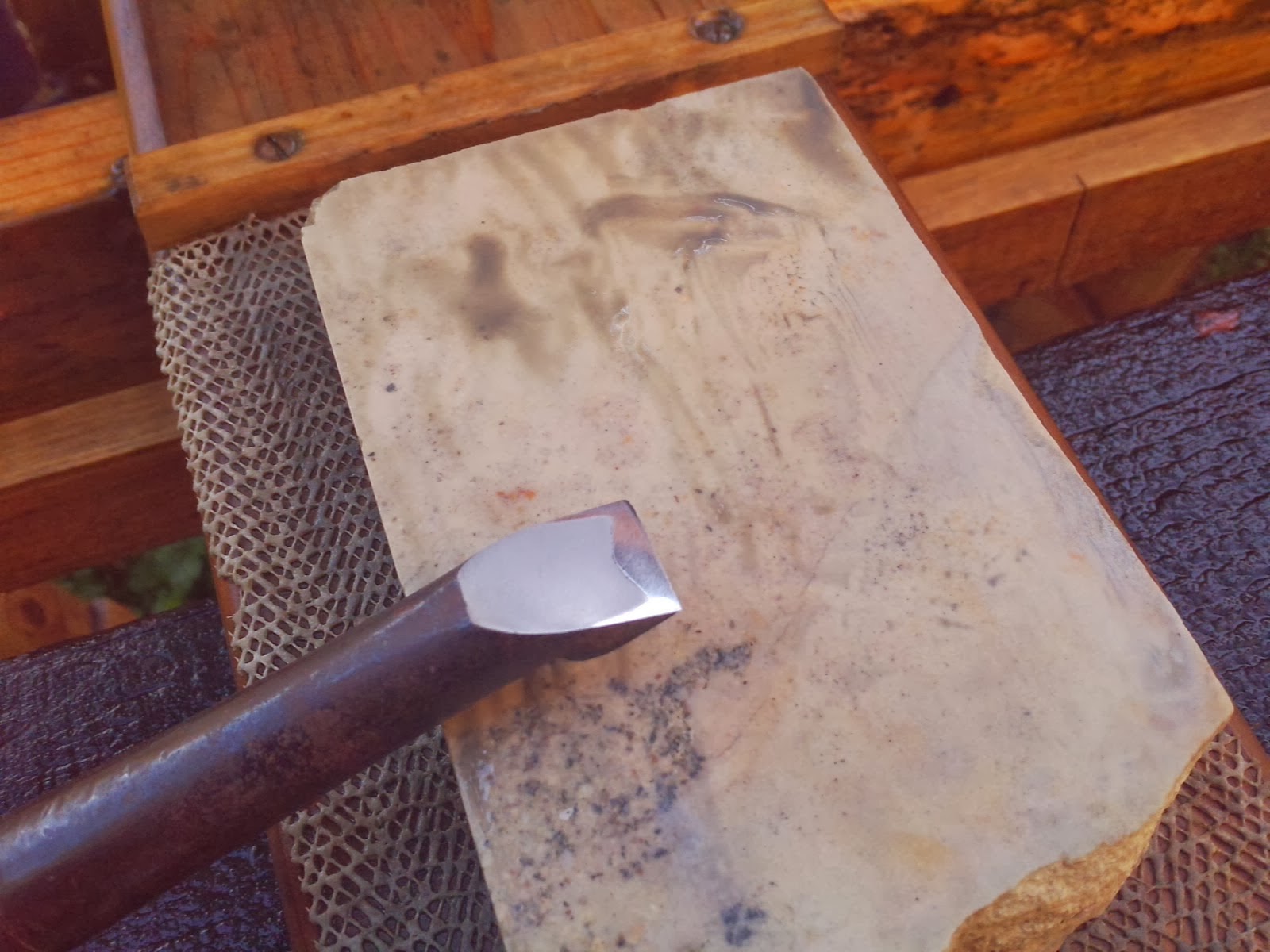
The front side abrades well, though! This was 2 minutes (after the hard gray shale) and the slurry is nice and dark with steel particles. The scratches from the HGS are pretty well gone. Some scratches are visible, but I don't know if they are from this stone, the HGS or the DMT diamond. Nice polishing action. Feels a bit "sticky".


So for S&G'ls, I rinsed the stone off and used the ODC as a nagura stone to form a thin slurry, and worked the chisel for 1 minute. VERY different feel! The ODC feels gritty but slippery and very smooth. Abrasion was fast, thin slurry thickened and turned dark almost immediately. Finish is a slight haze and very even.


Nice hazy mirror, maybe 4000 grit (JIS). Some coarser scratches are visible but I still don't know where they are coming from.

The stone by itself was pretty easy to use, a bit sticky, and I got the feeling that if I was patient, it would completely polish the edge to a full mirror state. There is some scratching, however I am not sure of the source. More testing! For being a light, low density stone, it is surprisingly stable dimensionally and shows little tendency to cup. It feels like it would dish out super fast, but it doesn't. Wear is fairly even. The areas with the darker particles has a different feel, with the specks as small bumpy patches. Not particularly scratchy specks, though. Might be a good high polish stone. Maybe an uchigumori stone?

The difference between the front and back side's cutting power is strange. It doesn't seem likely that the difference would be sooo dramatic.....MORE TESTING!

Using the ODC nagura made this stone really come alive. Very easy, smooth and fast. Even finish, light touch, even wear. Still didn't make that much difference on the back side, however. That tells me that the abrasive action is NOT solely due to the ODC nagura, but that there is a different particulate material in that strata.

Thumbs up! I have a bigger, more homogeneous stone on the wish list.