Tuesday, April 29, 2014

Hirosada kanna and Cubs-Torasaburo..... and the mysterious "mark".


So I got this new/old kanna.......


It seems nice enough, but what's the story? Unfortunately, what little information there is about these old tools (and there doesn't appear to BE much info.... Even the Japanese guys say so.) is, of course, in Japanese. I learn what I can using Google translate, probably enough to get everything wrong, but it's what I've got. Please don't assume that this is correct......


I have mostly stopped trying to track down provenance on my Japanese tools, because they are almost all mid-upper range wholesalers branded blades (It seems like over 85% of these old Japanese tools have been produced for wholesalers). This kanna has piqued my curiosity, though. All I know is what Junji says, that it says Hirosada.

A Google search of Hirosada+kanna images, if followed far enough, brings up some images from Tanaka Kiyoto's (my hero!!) blog.


Bingo!

His post details using two kanna, made by the same blacksmith, but for two different companies. The blades are Cubs-Hirosada (maybe Togo steel) and Azuma-Hirosada (Yasugi  blue steel). If Tanaka Kiyoto is curious, well.....


Copying the original kanji from Tanaka Kiyoto's post, brings up a better set of image results, among which was......


Bingo! Pro-shop Hokuto has one pristine kanna set (¥38,500, about $375 usd), and a bare blade with some discoloration/rust (¥23,000, about $224 usd). Yikes! 

The cubs-Hirosada blade was made for a company, Cubs-Torasaburo, that produced blades through most of the 1900's. This blade dates (probably) from the early to mid Showa era, so around 1950'ish. At this point, I get pretty confused, but the gist seems to be that the company is a group of 4 brothers (one of which was a blacksmith) and acted primarily as a blade wholesaler. This blade was signed by the true maker, if I understand properly. 

For some reason, the Azuma-Hirosada blades are less expensive, closer to $100, and this might be due to the type of steel used. The cubs-Hirosada uses togo steel (maybe), and has a reputation for being hard and very difficult to sharpen (Togo-reigou?), while the Azuma-Hirosada is made with Yasugi blue steel (more common). Some of their other blades were made by master craftsman, but the the names of the makers were kept hidden. 

My thought is this. Say that you are a blacksmith , and you makes good blades, but times are tough. To make ends meet, you arrange to sell some blades to a wholesaler, but the wholesaler can't put YOUR name on the blades, because that would kill your direct sales. You still got to eat, right? So now, 80 years later, we have some wholesaler names that have this reputation of selling these "hidden master" or "master craftsman/ Meisho” blades that would cost 10X more, but for the name. Etsuei is another wholesaler with a similar reputation. 

Monday, April 28, 2014

Another new/old kanna---Cubs-Torasaburo Hirosada kanna


With so many tools to play with, it's a wonder that I get anything built at all.

I am in the market for a router plane. A router plane is another of those tools that you never knew that you needed. They do come in a few different sizes, so I have been straddling the fence for a while, trying to decide which size will be most useful for me. Luckily for me, I know the perfect guy to ask for some loaners.


My friend Brandon is selling off the better part of his antique tool collection, prior to sailing off into the sunset, but he still has more tools than any same person should. Fortunately, he was able to loan me a few of his router planes, so I could get an idea of what size tool I might prefer. His treasures are gradually being made available on eBay (seller ID:unionlover), so check there periodically if your tastes run to the vintage western tools.

Junji/yusui also sent a few more tools from the "Jason" box.


It amazes me that I can buy some old tool, that's been sitting for god knows how long, and the thing will actually be sharp. It's as though the craftsman actually sharpened their tools after using them. What a novel idea! These three need barely any work, just a bit of freeing-up, as the wooden bodies have shrunk some over the years and are too tight for my tastes.


So what's the story on this guy?


It has a very grimy dai, but it is almost full height still, so it hasn't seen much use and it feels like a quality tool. 

The blade is almost full height too.


Ouch!! Both blades are well made, but the main blade has a big chip knocked out of the edge and it has been sharpened very unevenly. 


The amount of skew is nearly 6mm! The broken portion is about 20mm long.


I had assumed that the edge broke during an overly enthusiastic ura-dashi session, but I don't see any hammer marks on the bevel. The blade is VERY sharp, so I'm guessing that it was one of those "Oops/Sonofabitch!!!" Moments.


The bevel is very reflective, but tarnished due to the new rust treatment that Junji has been subjecting his tools to. Rather unfortunate.


The kanji are very simple, and are unusually positioned, being very low and extending into the urasuki. 


These would have actually been stamped by the blacksmith, and the ura ground prior to heat treating/hardening. The urasuki was probably forge-black, prior to it's acid bath/de-rusting treatment.


Chris Hall (The Carpentry Way) is doing a thorough and professional series of articles (This one explains the importance shaping the ura on a new blade) that pertain to setting up a new kanna. My work deals more with damage control. 


Fat ashi and deformed blades are my lot in life, it seems. 

The back/secondary blade is very nice, and signed, but has a different title I think. The mei doesn't match. 


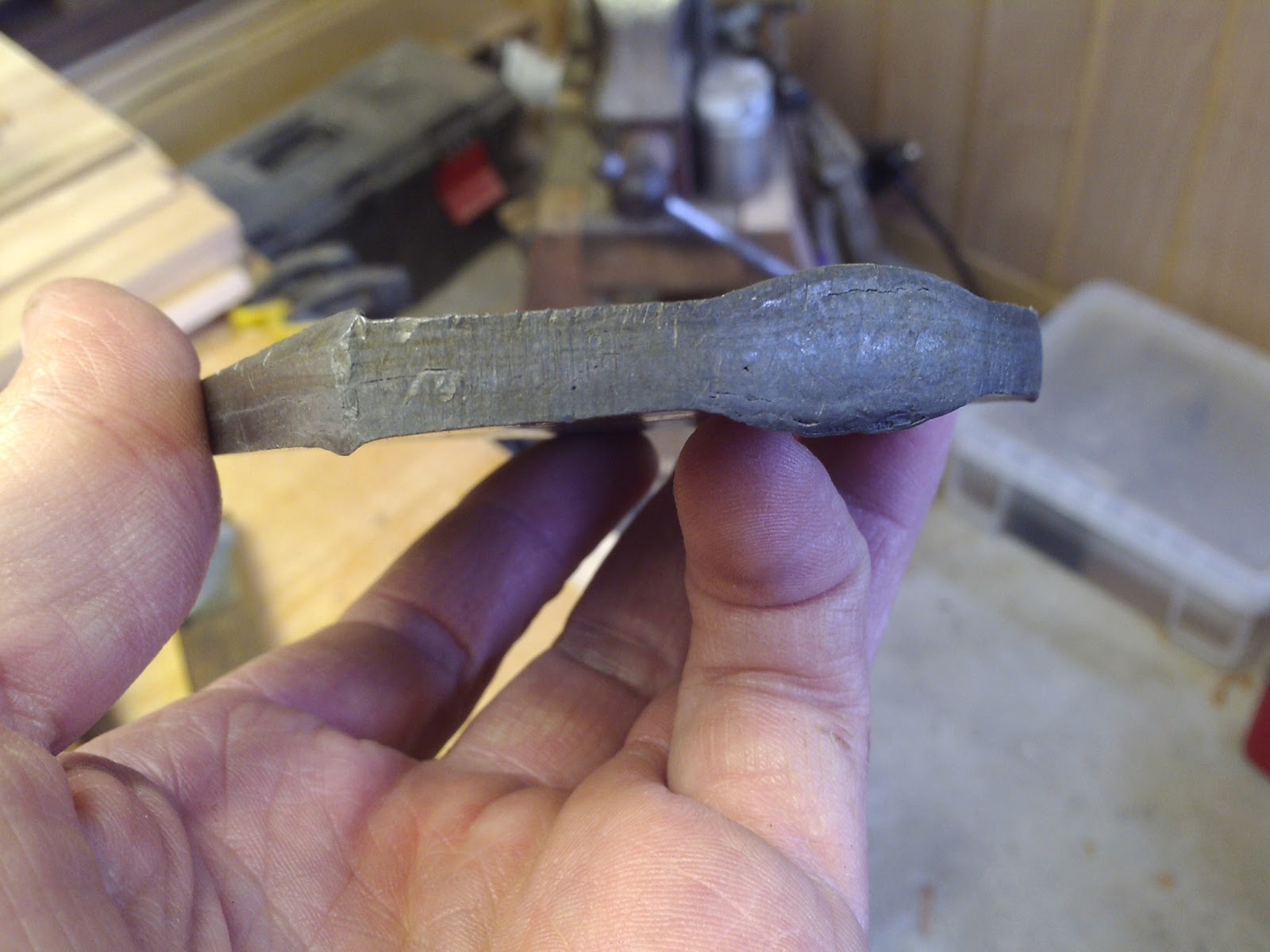
The head of the main blade is deformed, primarily in two areas.  On a positive note, the acid de-rusting treatment makes the wrought iron laminations very distinct! 


Dendrochronology of kanna blades. 


If you were to take a steel hammer, and whack the blade in the deformed areas.....


.....the cutting edge lines up perfectly!


Ouch! That chip is nasty. Look at the reflection, though. That steel is VERY bright!


The cutting edge is sharp..... AND the dai is true. The contact points are good.


The hollow areas on the sole of the kanna look like they were planed, not scraped. Rough and ready. 


I get the distinct sense that this carpenter belonged to the "Bigger hammer" school (as in, "Hit it with a bigger hammer. Make the Damn thing fit!").

The real bummer about this kanna. 


The blades were bashed around so much, the abutment has been damaged. This will mostly affect the tightness of the secondary blade, so I will withhold judgment for the time being. The dai is so nice otherwise, I am loath to scrap it.


So here we have a seemingly high quality tool, with well forged blades of good steel paired with a stable, well aged dai. The prior owner might have had some anger management issues, or he might just have been impatient and in a hurry to get some wood planed. He knew how to sharpen a blade, though!


Veeeeerrry interesting....... Curious...

More?


Wednesday, April 23, 2014

eBay junker Jnats


Just when I think that I am immune from buying more natural waterstones......

Last night concluded some eBay auctions that a few of you might have been watching, of which there were a number of Japanese waterstones, both natural and synthetic. I would be the first to admit that I already have more sharpening stones than I need, but it's still fun to look, right?


Please bear in mind that I am FAR from experienced in the whole Japanese natural waterstone department, so this will be of no real value, but it is fun to guess. If anyone cares to comment and present their own opinions, this will be even more fun (at least for me!). In retrospect, I should have bought all three. Then we could do a "Guess-the-stone" roundtable. We could've sent the actual stones on a rotation, to try out in person....... THAT would've been REAL fun! Perhaps one of you bought some of these? If so, please contribute!

That said, here are the 3 that I was most interested in. The color balance of this seller's photos has changed recently, as he has started using new backgrounds with his descriptions. I have NO idea how "off" these pictures are. None of these stones had a detailed description, just size, weight, and a guess as to the fine/coarse nature, and in my experience, the seller is not an experienced user, so we get to guess.


This looks like a nice finising stone, with a fine grain structure visible on the chipped, natural edges. The greenish color with a more diffuse/mottled rosy color towards the upper edge has me thinking "Tomae". Size is about 210-72-15 mm, 1039g,  but looks like it could be sitting in a carved recess, so it may be slightly thicker. It sold for $131.50. That would be a GREAT price for a decent Tomae!


Is it a Tomae? I think of Tomae as being more tan than green, and hard.

The amount of old slurry still collected around the edges has me thinking that this would be a pretty soft stone, so it might be from a different layer. Anyone?..... Anyone?...... Bueller?......Bueller?


When I see auctions that have a number a different stones/tools, whatever, I like to imagine that there was one original owner. What did this person do? How were these tools used?  For these stones.........I am gonna guess that these were used for sharpening knives. This looks like a great stone for finishing kitchen knives, not TOO fine, and soft, to slightly ease the bevel. I like to use a slightly soft stone when finishing a large single bevel blade. This looks like a nice stone.


209-62-66 mm.  Blue/green towards white with a hint of purple specks (renge?) Some lines, with darker staining from solute migration. Some of the photos hinted at possible small white spots..... Nashiji? I am going to guess that it is some sort of Suita.


The sides are rough and dirty. I didn't see any distinct layering. This stone looks virtually new/unused, and based on the pictures, the least attractive face was used as the work surface. Was this stone just not used very much? Why?

I think that this is the opposite face. I would like to try this side. It certainly is more attractive. You can't use just any face, though (Well, you can...... but).


With natural stones that are formed through deposition/sedimentary process, the orientation of the individual particles has a significant effect on the way that the stone functions. One face can feel sticky or rubbery, yet not be effective for metal removal. It will be doing more burnishing than actual sharpening. Roll the stone 90° and it might work well, like a completely different stone. Finishing stones are typically used flat grain ie: the grain runs side-to-side. Aotos are used end grain. The grain goes up and down through the thickness of the stone.  

I bet that if THIS were the working surface, this stone would've sold for at least twice as much, and quite possibly more. As it is, it sold for $71, a steal (probably), but the hanger for me was the $55 shipping. The stone weighs 2100g. That extra 100g doubled the shipping charge, because anything over 2000g gets shipped EMS (like fedex, fast but spendy).


My mother gave me an eBay gift certificate for my birthday (Thanks Mom! How did you ever guess?!!), so feeling flush, with money to burn......

A spin of the roulette wheel. This nasty thing was identified as a synthetic stone, and I suspect that is why there was only 1 other bidder. Well..... AND it's really ugly looking. 210-65-33 mm. 727g. 


The mottled color might just be staining from sitting outside in the rain for years.


The rough edges look like spalling due to freeze/thaw cycles. It COULD'VE been a perfectly formed rectangle at some point in time.

It is significantly dished on both primary faces, top and bottom. 


There is the remnant of a manufacturers ink stamp on one edge, and you can see that it says "Trade mark". This stamp is the only thing that gives me pause (Hahahaha!.....Well, that and the whole "synthetic" thing in the description), because I have a strong suspicion that using English to identify the product means that it was intended for export. Export=mass production=crap intended for people who don't know any better (like me, haha!) I bet the eBay seller saw the stamp and thought "synthetic".

What do I like? Why do I think that this is a natural sharpening stone? 


The color is mottled on all faces, and extends into the interior of the stone. A synthetic would only show discoloration on the surface. The spalling exposed the grain structure of the stone so you can see the "inside", as it were. If you enlarge the photo, the interior looks like it HAS grain structure. A synthetic has no grain, it looks even, is amorphous. This stone shows cleavage planes and what look like small inclusions of disparate minerals. Even taking into account the spalling, I doubt that this stone was ever a perfect rectangle and a manufactured stone would be even, of course. I think it's a Jnat.

I would guess a binsui or white Amakusa, but the Amakusa's have small voids/pores and a softer particulate "feel". This looks to be a more solid, crystalline structure. I would expect it to appear almost pearlescent. Hope springs eternal, right? 

Whatever it is, it was used for sharpening knives. The dishing looks like what you get from a right handed sharpener shaping long blades. Dishing is anathema for carpentry tools like plane blades, but works very well for long edges, like kitchen knives, that don't require exact angles and would be preferred by some users. Hell, even I let the bevel get a bit convex on our kitchen knives, and I think it's clear how anal I am about flat bevels! 

I will guess that this is a natural stone, maaaaaaybe a Suita, and was used for primary bevel setting, and about #2000-3000 grit. The opening bid was $5.99, I think, and there was only one other bidder. I hoped to win it at $7, but was pleasantly surprised to learn that the other bidder had gone higher ($20), but not too high. $20 would be WAY too much to pay for an old synthetic stone, in this condition, so I am thinking that the other bidder was thinking along the same lines as me, that this is a natural sharpening stone and not some old  $5.99 carborundum sickle stone.

I guess that I'll find out soon. Any guesses?