Showing posts with label Eze-lap diamond bench stones. Show all posts

Tuesday, May 20, 2014

Experimenting with diamond grit

I am still in search of my Holy Grail, an effective coarse grit sharpening stone. Preferably one that stays flat, works well with multiple metal types, and eats steel faster than the kid I used to sit next to at lunchtime. Oh yeah, cheap too. My personal Holy Grail would be a natural stone as well...... We can hope, right?


I have used valve grinding compound (silicon carbide in a grease carrier). It's cheap, available at any auto parts store, and it works tolerably well.
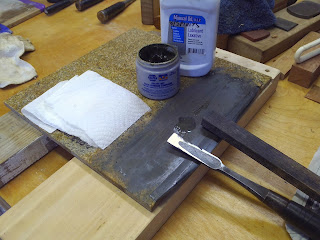
You need to find a good substrate, though. This pink granite tile shows significant wear after lapping the backs of 4-5 chisels and a couple of really hard kanna blades.


Don't do this with your nice granite surface plate, OK?


I have a real love/hate relationship with diamond bench stones. Of the two DMT Duosharp stones that I have had, neither was particularly flat (one was seriously NOT flat), both very quickly lost their initial aggressiveness (minutes) which was replaced with a very lackluster bland feeling (forever), both left random large scratches (forever), and both quickly lost their nickel coating at the edges and corners (months). Both were expensive, too.

 The two Eze-lap stones that I have are not flat, but aside from that, still work well after years of use. All diamond stones lose some aggressiveness/harshness as they get broken in, but at least the ezelaps feel like they are still working.

 The cheap Chinese stones that I have wear similar to the ezelaps and are sooooo inexpensive, they would be perfect, if only they were flat.

 I want a diamond stone that has that firm "bite" of a good, coarse sandpaper, and if it could be recharged as it's performance began to fall, more the better. To that end, I have been experimenting with the use of loose diamond grit. The question is what type of substrate will work best. One other wrinkle..... I want to be able to use this for sharpening the bevel side. Others have said that loose diamond works poorly for doing bevels. Why?


I have some thick pieces of acrylic, the remnants of a bunch of old boat hatches that I didn't have time to use. You want to use a substrate that will allow the diamond grit to sink into, to grab onto, rather than just rolling around on the surface, and acrylic seems like it would work well.


I am using a 125-106 micron size, pretty coarse, about a #125 grit.

I put a small pinch into a syringe with a bit of glycerine as a carrier.


I sanded the acrylic to give it a bit of "tooth", then applied a little of the diamond compound. This is just the smallest fraction of what's in the syringe.


I used a piece of hard D2 steel to rub the stuff around, trying to distribute the diamond grit somewhat evenly. The black stick is a piece of oak that helps me bear down on the steel, really grinding the diamond into the substrate.


It works!


It feels funny, though, like the diamonds are mostly rolling around on the surface, instead of bedding in properly.

As the glycerine dries out, it needs to be scraped off of the blade. It is black from all of the iron and steel swarf, and I can't help but wonder how much of this is diamond that didn't embed. Rather than discard this stuff, I wet it slightly, then spread it around as though it was a typical waterstone slurry. You can feel the abrasive diamond rolling around still, and the feedback is pretty poor.


You can see the sparkles of diamond that DID get embedded into the substrate.

The glycerine rehydrates using just a spritz of water. Can't decide whether it is working better wet or dry.


The swarf and grunge rinses off very easily, using just a spray bottle. When I wipe off the nastiness, you can see that the diamond has been well distributed, but the concentration is thin. 


I add more diamond compound to the plate, but it feels like it has reached a short of maximum capacity. This might be a misperception, but secondary (and third) applications don't dramatically improve the "feel" of the lapping plate. 

The feel is hard to describe. There is a very distinct "grab" as though some of the diamonds are much larger than the others and cut deep grooves in the metal. The combination of coarse grit and deep grooves makes the plane iron steer funny. The blade gets pulled around rather than floating, and you get the sense that moving the iron back and forth is just riding in the same grooves rather than removing new metal.

It would be nice to get this figured out, as I have more window sills to plane. The Port Orford Cedar requires a very sharp edge for a nice finish.



Monday, March 31, 2014

Diamond bench stones-DMT and Eze-lap..... and a bit about lapping substrates

I seem to be having one of those days where I would rather talk about something , than actually DO it. Well, that and wanting to clean out some pictures before I forget what the pictures pertained to. Something like that. These are just some thoughts based on my VERY limited experience......


All of these sharpening stones that I have been making, every one needs to be flattened. I have been doing that using various combinations of loose abrasive grit on a flat (ish) substrate. This has proved to be so much faster than, say, sandpaper on a flat surface, that I can't imagine ever using the sandpaper method again. Loose grit is faster AND gets the surface flatter, win-win.

For tools, the choice is not as simple. I have piles of old tools and most of them require fairly substantial reworking. This means removing lots of metal, and even *I* get tired of grinding away for hours on end, at least if the time/work curve feels painfully flat. I do use power tools, grinders and the like, but I prefer handwork, IF the T/W curve is reasonable.

I am going to be trying loose diamond grit on a lapping plate, but for now, I just want to make some surfaces flat. I have been using a flat granite tile and valve grinding compound....


.....but the level of wear is unacceptable.


This was after only about 12 blades (2 were amazingly hard, though).


So. Diamond stones. The hand sharpener's Crack cocaine... And they are flat, right?


Two stones, a DMT duo-sharp and an Eze-lap #600 grit.


The DMT I bought new, about 1 year ago. The Eze-lap is from my friend Brandon, and is old, 10 years? 15? It has seen some use, definitely. The Eze-lap (10 years old) works great, but the DMT (1 year, maybe) is getting decidedly tired, and is also starting to delaminate. 

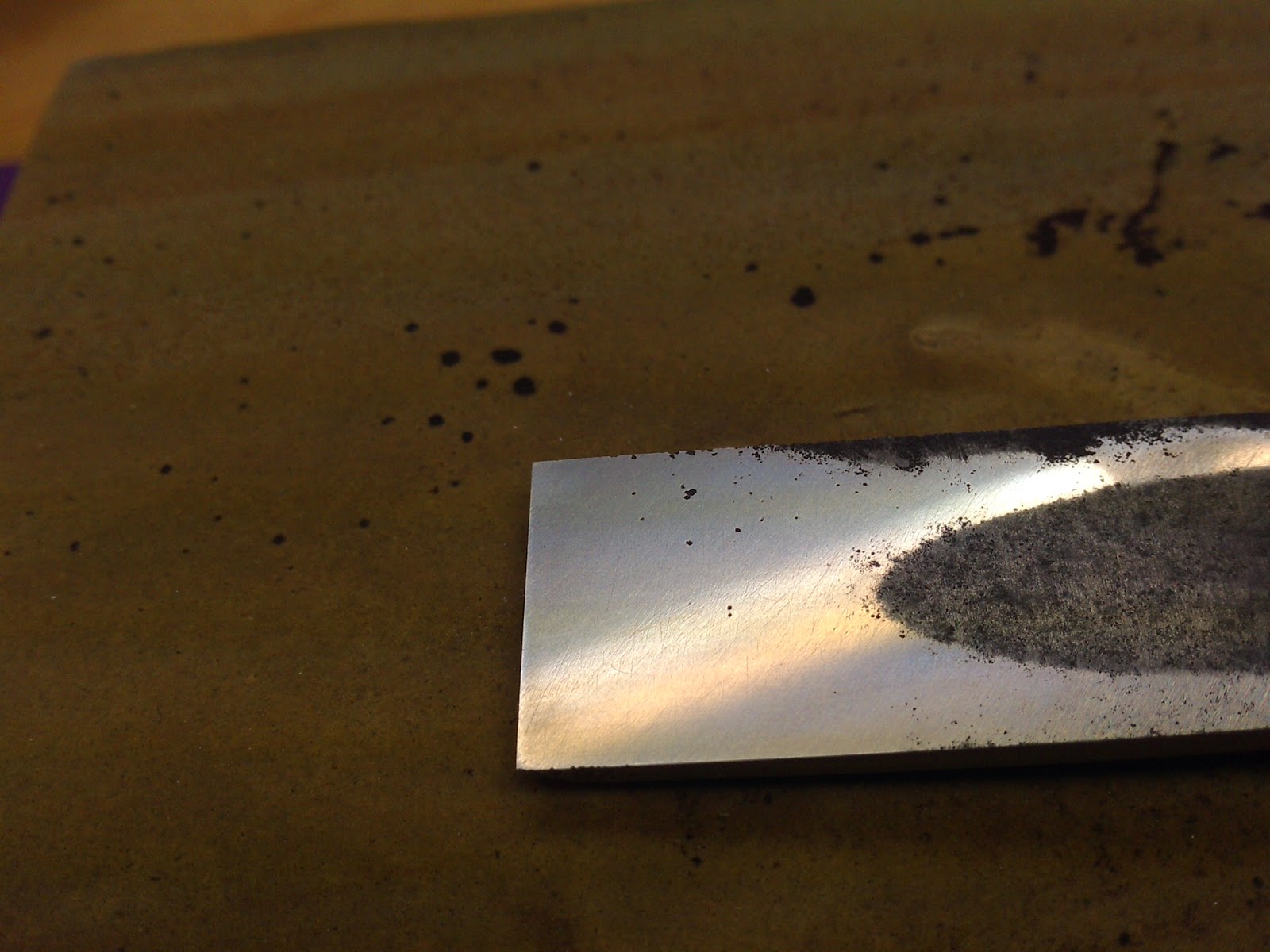
It's also bowed +1/64 along its length. Always has been. Many people have found this to be the case, particularly with the perforated composite stones.


Significantly bowed, for what is widely advertised as "very, very flat". The company that makes the DMT'S advertises 0.001/inch for their regular bench stones, and supposedly BETTER for these duosharp stones. 1/64 over 8" = 0.00195, almost double the target 0.001. Decidedly bowed. 

The problem with the bowed sharpening stone is this. Say that you begin with a flat blade. Using this stone, you will make your blade first concave (#600 Fine), then convex (#1200 Extra Fine). Then you have to flatten the blade all over again using your finishing stones, which takes a while. All told, you have removed about 4X more material than you would if you were using a TRULY flat stone. I like sharpening things but......


The Eze-lap is usably flat....


....but that's because I made it that way.


A BIG vise and LOTS of pressure, these are made from hardened steel and are very sturdy. You can see that my little fulcrum block is crushing. I had to use two hands and extra ooomph! to tighten the vise, just shy of needing a breaker bar. Very sturdy! I obviously can't do this with the DMT, bummer.

Worse, however, is the scratching. The DMT has #600 (F) one side, #1200 (XF) on the other. The #600 (F) is consistent in it's degree of aggressiveness, but tired. The #1200 (XF) side is very uneven, with approximately half being an appropriate #1200, while the other 1/2 feels more like a #400 grit AND has a few random, huge particles, just to keep things interesting. I'm starting to wonder if I got a bad one......


At least I finally found out where my mystery scratches are coming from. I get these scratches on every tool that touches the DMT, and they take RIDICULOUS amounts of time to remove. Heck, this thing even left scratches on my sharpening stones, before I figured things out. Now I try to use stone/stone to true my sharpening stones. You need to use a DIFFERENT diamond stone to remove the scratches left by this stone, far from efficient. Ergo, the Eze-lap stones.

The two stones use different types of diamond grit. The DMT uses a mono-crystalline diamond abrasive that they say is better/more expensive/higher quality/longer lasting etc. The DMT does leave a nice, even scratch pattern, at least on the #600 side.

The Eze-lap #600 uses poly-crystalline diamonds and though old and worn, still is MUCH faster than the DMT, although the finish isn't quite as fine. This is consistent with other people's findings. You can read a bit about the mono/poly debate in various venues, written by people with WAY more experience the I.

Like this one....

sawmillcreek. Synthetic-polycrystalline-diamond-paste-cheap-and-otherwise

The consensus is that mono starts fast, wears out fast, and produces occasional large scratches. They are more expensive, too. Sounds familiar. My $8 set of (not so)crappy Chinese diamond stones are still working fine, even though they get abused on a daily basis. They are most likely poly diamonds. Seriously, just today I did the rough shaping of an old kanna blade, worked on the initial flattening a MF'ing hard potential sharpening stone, chamfered the edges on another stone, sharpened an old Japanese ax, and (finally!) worked a bit on flattening a cast iron lapping plate.


I am going to send my DMT in for evaluation. I'll let you know how that goes. Today, I would give 5 DMT's for 1 old Eze-lap. Maybe 7. Probably not 10, though. I mean, it DOES still work. I have read that some of their other products are more consistent in the lateral plane ie: Dia-flat lapping plate @.0005/inch.

Kinda spendy, though.