Showing posts with label DMT. Show all posts

Tuesday, May 20, 2014

Experimenting with diamond grit

I am still in search of my Holy Grail, an effective coarse grit sharpening stone. Preferably one that stays flat, works well with multiple metal types, and eats steel faster than the kid I used to sit next to at lunchtime. Oh yeah, cheap too. My personal Holy Grail would be a natural stone as well...... We can hope, right?


I have used valve grinding compound (silicon carbide in a grease carrier). It's cheap, available at any auto parts store, and it works tolerably well.
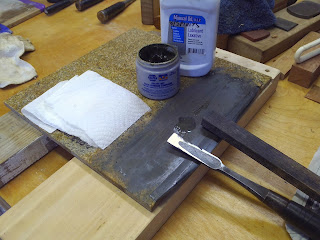
You need to find a good substrate, though. This pink granite tile shows significant wear after lapping the backs of 4-5 chisels and a couple of really hard kanna blades.


Don't do this with your nice granite surface plate, OK?


I have a real love/hate relationship with diamond bench stones. Of the two DMT Duosharp stones that I have had, neither was particularly flat (one was seriously NOT flat), both very quickly lost their initial aggressiveness (minutes) which was replaced with a very lackluster bland feeling (forever), both left random large scratches (forever), and both quickly lost their nickel coating at the edges and corners (months). Both were expensive, too.

 The two Eze-lap stones that I have are not flat, but aside from that, still work well after years of use. All diamond stones lose some aggressiveness/harshness as they get broken in, but at least the ezelaps feel like they are still working.

 The cheap Chinese stones that I have wear similar to the ezelaps and are sooooo inexpensive, they would be perfect, if only they were flat.

 I want a diamond stone that has that firm "bite" of a good, coarse sandpaper, and if it could be recharged as it's performance began to fall, more the better. To that end, I have been experimenting with the use of loose diamond grit. The question is what type of substrate will work best. One other wrinkle..... I want to be able to use this for sharpening the bevel side. Others have said that loose diamond works poorly for doing bevels. Why?


I have some thick pieces of acrylic, the remnants of a bunch of old boat hatches that I didn't have time to use. You want to use a substrate that will allow the diamond grit to sink into, to grab onto, rather than just rolling around on the surface, and acrylic seems like it would work well.


I am using a 125-106 micron size, pretty coarse, about a #125 grit.

I put a small pinch into a syringe with a bit of glycerine as a carrier.


I sanded the acrylic to give it a bit of "tooth", then applied a little of the diamond compound. This is just the smallest fraction of what's in the syringe.


I used a piece of hard D2 steel to rub the stuff around, trying to distribute the diamond grit somewhat evenly. The black stick is a piece of oak that helps me bear down on the steel, really grinding the diamond into the substrate.


It works!


It feels funny, though, like the diamonds are mostly rolling around on the surface, instead of bedding in properly.

As the glycerine dries out, it needs to be scraped off of the blade. It is black from all of the iron and steel swarf, and I can't help but wonder how much of this is diamond that didn't embed. Rather than discard this stuff, I wet it slightly, then spread it around as though it was a typical waterstone slurry. You can feel the abrasive diamond rolling around still, and the feedback is pretty poor.


You can see the sparkles of diamond that DID get embedded into the substrate.

The glycerine rehydrates using just a spritz of water. Can't decide whether it is working better wet or dry.


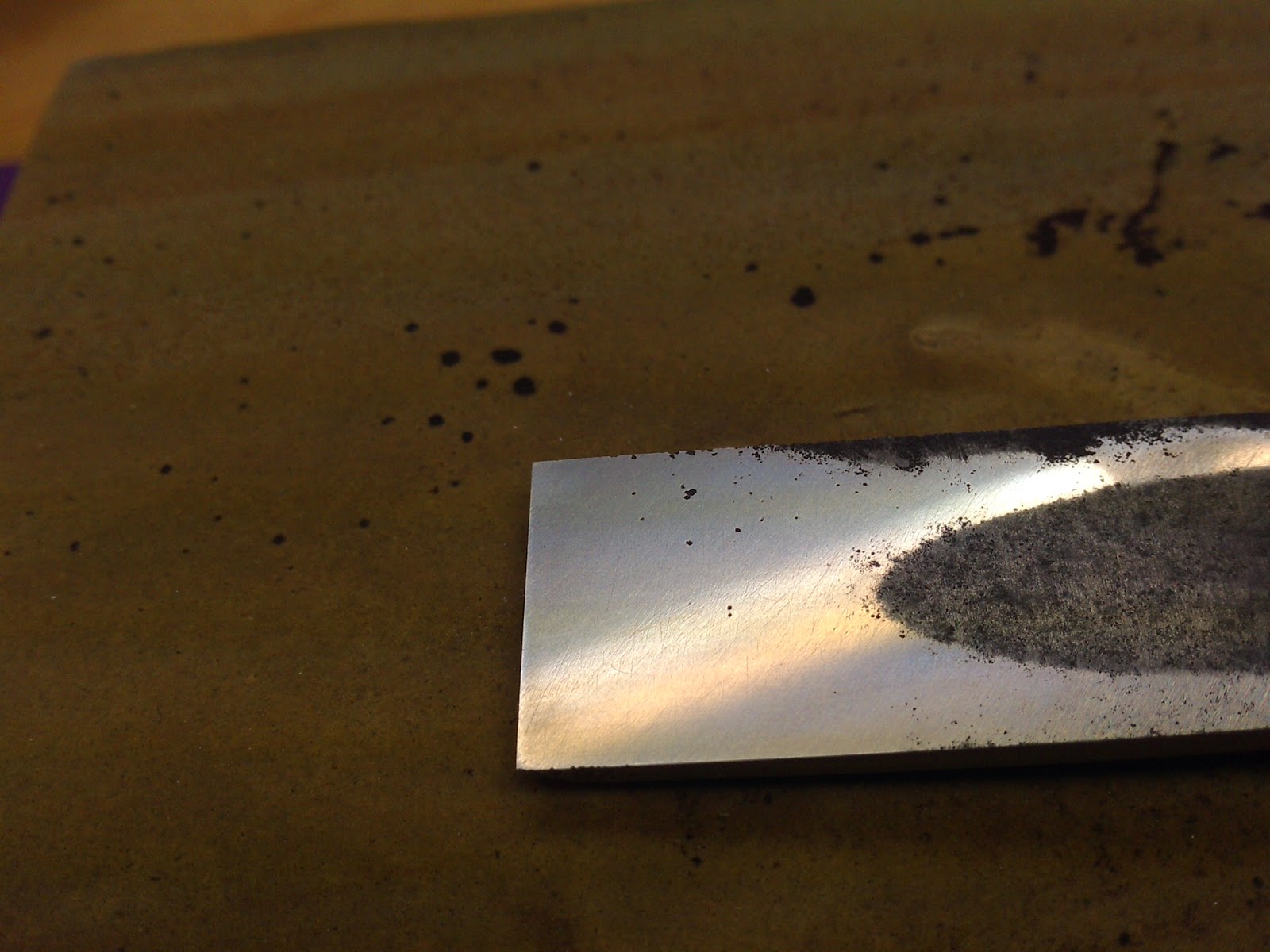
The swarf and grunge rinses off very easily, using just a spray bottle. When I wipe off the nastiness, you can see that the diamond has been well distributed, but the concentration is thin. 


I add more diamond compound to the plate, but it feels like it has reached a short of maximum capacity. This might be a misperception, but secondary (and third) applications don't dramatically improve the "feel" of the lapping plate. 

The feel is hard to describe. There is a very distinct "grab" as though some of the diamonds are much larger than the others and cut deep grooves in the metal. The combination of coarse grit and deep grooves makes the plane iron steer funny. The blade gets pulled around rather than floating, and you get the sense that moving the iron back and forth is just riding in the same grooves rather than removing new metal.

It would be nice to get this figured out, as I have more window sills to plane. The Port Orford Cedar requires a very sharp edge for a nice finish.



Monday, March 31, 2014

Diamond bench stones-DMT and Eze-lap..... and a bit about lapping substrates

I seem to be having one of those days where I would rather talk about something , than actually DO it. Well, that and wanting to clean out some pictures before I forget what the pictures pertained to. Something like that. These are just some thoughts based on my VERY limited experience......


All of these sharpening stones that I have been making, every one needs to be flattened. I have been doing that using various combinations of loose abrasive grit on a flat (ish) substrate. This has proved to be so much faster than, say, sandpaper on a flat surface, that I can't imagine ever using the sandpaper method again. Loose grit is faster AND gets the surface flatter, win-win.

For tools, the choice is not as simple. I have piles of old tools and most of them require fairly substantial reworking. This means removing lots of metal, and even *I* get tired of grinding away for hours on end, at least if the time/work curve feels painfully flat. I do use power tools, grinders and the like, but I prefer handwork, IF the T/W curve is reasonable.

I am going to be trying loose diamond grit on a lapping plate, but for now, I just want to make some surfaces flat. I have been using a flat granite tile and valve grinding compound....


.....but the level of wear is unacceptable.


This was after only about 12 blades (2 were amazingly hard, though).


So. Diamond stones. The hand sharpener's Crack cocaine... And they are flat, right?


Two stones, a DMT duo-sharp and an Eze-lap #600 grit.


The DMT I bought new, about 1 year ago. The Eze-lap is from my friend Brandon, and is old, 10 years? 15? It has seen some use, definitely. The Eze-lap (10 years old) works great, but the DMT (1 year, maybe) is getting decidedly tired, and is also starting to delaminate. 

It's also bowed +1/64 along its length. Always has been. Many people have found this to be the case, particularly with the perforated composite stones.


Significantly bowed, for what is widely advertised as "very, very flat". The company that makes the DMT'S advertises 0.001/inch for their regular bench stones, and supposedly BETTER for these duosharp stones. 1/64 over 8" = 0.00195, almost double the target 0.001. Decidedly bowed. 

The problem with the bowed sharpening stone is this. Say that you begin with a flat blade. Using this stone, you will make your blade first concave (#600 Fine), then convex (#1200 Extra Fine). Then you have to flatten the blade all over again using your finishing stones, which takes a while. All told, you have removed about 4X more material than you would if you were using a TRULY flat stone. I like sharpening things but......


The Eze-lap is usably flat....


....but that's because I made it that way.


A BIG vise and LOTS of pressure, these are made from hardened steel and are very sturdy. You can see that my little fulcrum block is crushing. I had to use two hands and extra ooomph! to tighten the vise, just shy of needing a breaker bar. Very sturdy! I obviously can't do this with the DMT, bummer.

Worse, however, is the scratching. The DMT has #600 (F) one side, #1200 (XF) on the other. The #600 (F) is consistent in it's degree of aggressiveness, but tired. The #1200 (XF) side is very uneven, with approximately half being an appropriate #1200, while the other 1/2 feels more like a #400 grit AND has a few random, huge particles, just to keep things interesting. I'm starting to wonder if I got a bad one......


At least I finally found out where my mystery scratches are coming from. I get these scratches on every tool that touches the DMT, and they take RIDICULOUS amounts of time to remove. Heck, this thing even left scratches on my sharpening stones, before I figured things out. Now I try to use stone/stone to true my sharpening stones. You need to use a DIFFERENT diamond stone to remove the scratches left by this stone, far from efficient. Ergo, the Eze-lap stones.

The two stones use different types of diamond grit. The DMT uses a mono-crystalline diamond abrasive that they say is better/more expensive/higher quality/longer lasting etc. The DMT does leave a nice, even scratch pattern, at least on the #600 side.

The Eze-lap #600 uses poly-crystalline diamonds and though old and worn, still is MUCH faster than the DMT, although the finish isn't quite as fine. This is consistent with other people's findings. You can read a bit about the mono/poly debate in various venues, written by people with WAY more experience the I.

Like this one....

sawmillcreek. Synthetic-polycrystalline-diamond-paste-cheap-and-otherwise

The consensus is that mono starts fast, wears out fast, and produces occasional large scratches. They are more expensive, too. Sounds familiar. My $8 set of (not so)crappy Chinese diamond stones are still working fine, even though they get abused on a daily basis. They are most likely poly diamonds. Seriously, just today I did the rough shaping of an old kanna blade, worked on the initial flattening a MF'ing hard potential sharpening stone, chamfered the edges on another stone, sharpened an old Japanese ax, and (finally!) worked a bit on flattening a cast iron lapping plate.


I am going to send my DMT in for evaluation. I'll let you know how that goes. Today, I would give 5 DMT's for 1 old Eze-lap. Maybe 7. Probably not 10, though. I mean, it DOES still work. I have read that some of their other products are more consistent in the lateral plane ie: Dia-flat lapping plate @.0005/inch.

Kinda spendy, though.


Sunday, November 17, 2013

DMT vs. Suehiro, sharpening mania and "True grit"

Why can't we all just get along?


Some kids just can't play well together.


Not just scratches, but specks too! Zoom WAY in.

I don't know what the deal is but these two just don't work together. HUGE scratches nearly every time I use the DMT diamond stone to flatten the  Suehiro 3000. Even worse are the occasional spec of whatever. I'm not sure if it is diamond or just a metal shard. Whatever they are, they DO chip blade edges.

This is a real bummer because I use the DMT quite a bit. In less than a year, the surface has become feathered out at the edges, with just base metal remaining. The thing never was particularly flat to begin with, being bowed along its length and slightly undulate. I use it to flatten the backs of irons, chisels, waterstones, pretty much anything that needs to be flat. Oh yeah, the DMT is also making the"Thunk!" of death which signifies incipient delamination. Before I resort to buying an Atoma diamond stone, I'll probably try a kannaban as I definitely have a thing for the old and obscure. You can't get much more oldschool than grit on a piece of steel. Yeah, kannaban and a chunk of cement....... that's the ticket!

I broke out the  artificials so that I would best know where any scratches were coming from. That is always a trick when testing a new set of stones. Say what you will, the man made stones are consistent in grit...... or are they? Even the artificials make their own distinctive pattern of marks caused by the relative size range of the particles used. Yeah, range. Not all one grit size. OR......the type of binder. A different binder will cause the abrasives to release at different rates, leaving a different finish.

I am testing out the new Siletz river shale and the finish that it left on a chisel was pretty good, but not perfect. Just a trace of scratching, but is it REALLY coming from the shale or somewhere else? I also wanted to see how it would finish a plane blade made using wrought iron as the base iron, so back to work I go..... but I keep getting these random but very distinct scratches, like something is imbedded in the stone/s. I had a nice, fast progression but would be left with a near perfect smoky mirror look.... with just the trace of scratches remaining.

Now this is COMPLETELY immaterial, it was a VERY good edge, but my curiosity ya know. Did I need to spend more time at the lower grits (like 2000)? Was the scratching from natural/synthetic/diamond? Back and forth, one stone at a time using contrasting indicator scratch patterns, using known (haha!) stones to polish up the edge, then back to square one again. And again. And again....

Suffice it to say that even MY mania has limits, and for the time being ALL stones are being put away....

Time to build something.

Tuesday, November 5, 2013

honegrown- Geological Specimen Supply (GSS) -

October 26

Geological Specimen Supply

Hard gray shale - Inyo range, CA

This was a sample that Rudy had kicking around that he thought I might like. It is a siliceous shale. Silica is good and sharp. I DO like it! He was right.

Surface #1 composition is uneven, with the darker 1/2 being more dense and slower wearing. Size is about 150-70-15 mm. 

Looking at the side, you can see that the layers of sediment are not perfectly parallel with the working surface. If I can get a thicker sample, I will lap the surface planar.

Side #2 is uniform in overall composition, but has inclusions of soft, rusty material. It doesn't scratch, but does wear unevenly.
This sample was so easy to lap, I thought that it might be too soft to work well. A while back, I found some nice muddy shale that abrades metal well but is so soft that it practically disappears just by looking at it. This stuff gets softer as it saturates, so even though it is a thirsty stone, I am not going to let it soak. After a few spritzes, it settles down. Actually, I need to try this one dry! It doesn't seem the type to load up or glaze. Hmmm......

Starting from P1200 grit diamond, lamination barely visible.

30 seconds and diamond scratches look to be gone. Lamination line is sharply defined.
Grit numbers are so funny. They seem very relative, although they are a measure of size and should be absolute. A P1200 grit sandpaper is pretty fine, on a stone it seems coarse. An abrasive particle can make a sharp, deep scratch or a rounded shallow scratch. I would guess this to be in the neighborhood of P1000 grit, JIS 1100, but these scratches are remarkably even and gentle and the stone is FAST! The well worn DMT leaves scratches that are deep AND sharp. As I was testing I thought that this stone was maybe as fast as my Tanba? which is my fastest natural stone. Of course I had to test it....not even close. This one is way faster! Slightly more coarse and a teeeny bit scratchy, but then again, it IS more coarse.

I am trying to get one of these shales that is bigger and of a more consistent composition. It's on my wish list. For a first shot and a guess, this is a really incredible stone. It is soft, so it wears pretty fast, but not any faster than my Tanba?, really. I want a really big one so that I don't have to worry about it wearing out. And to be clear, these were not intended to be sharpening stones, they are teaching aids. That they work at all is great, that they work REALLY well is amazing! I may sell Tanba?!

I use a DMT duo-sharp fine/x-fine because it is somewhat of a familiar standard for hobbyists and because it is flat-ish and stays that way, but as I do these comparison tests, I end up polishing blades way more than I otherwise would. THAT'S when you see how deeply diamonds scratch, even well worn ones. I plan to experiment with using a kanaban, but if that doesn't seem like a fit for me, I'll be getting an Atoma diamond plate, not another DMT.


Wednesday, July 31, 2013

More tool improvement (diamond sharpening plates)

Here's a quick one. Remember those cheap import diamond bench stones from the prior post?

Cheap and worth buying
I had glued them to some pieces of cedar that I had lying around the shop, which made them a lot more rigid and therefor, useful.

diamond bench stones on substrate
v. 1.1

The problem was that the "stones" are just thin pieces of diamond coated metal, adhered to almost as thin pieces of plastic. And that plastic is not dead flat (what do you expect for $7 and change?). So.......

v. 2.0
I took a putty knife and popped the metal plates off of the plastic substrate. I think that in a few more days, the plates would've just fallen off on their own anyways, so this just sped up the inevitable. As before, spray glue and stick down. Clamp them and give 'em a few minutes for the glue to set and.........FLAT!

Cheap and now FLAT!

The spots of light are just those little divots that are all over the surface of the plate. It is as flat as can be (at least in my shop) and is now actually more accurate than my MUCH more expensive DMT duosharp stone

Not as cheap and not as flat either
Don't get me wrong, the DMT Duosharp isn't too bad and I use it for lots of stuff, but a precision instrument it is not. The DMT diasharp continuous surface bench stone IS flat, if that's your thing.

I love quick, cheap projects.

Friday, July 5, 2013

Diamonds are a carpenter's best friend

Looking at those horrible photos of my unfinished workbench kinda reminded me that I had intended to actually build some drawers for the thing. Which means that I've got a lot of stock to machine up (I am in no way a hand tool purist) , but before that happens, I've got a secret to tell. I have never replaced the planer blades in my old Delta planer.
Delta 12 inch planer sharpening blades
Good old Blue/Gray
And it shows, big time. Just like not washing the car until it turns green, I was able to put off buying new knives and enduring minor tear-out, for a long time. Then I bought a bunch of Port Orford Cedar (POC). This wood is beautiful and when perfectly planed, leaves a shimmering almost iridescent surface.

Port Orford cedar box oil finish slat top
Port Orford beauty

This is from Merriam-Webster;
cha·toy·ant
adjective \shə-ˈti-ənt\

Definition of CHATOYANT

: having a changeable luster or color with an undulating narrow band of white light <a chatoyant gem>

Origin of CHATOYANT

French, from present participle of chatoyer to shine like a cat's eyes
First Known Use: 1816


REALLY nice stuff, but rather prone to tear-out when planing. Old Blue/Gray could still handle mahogany (amazingly well after 20 years and possibly 1000ft linear with only minor honing) with no problem, but POC? No way. So this last winter, I took a few days and sharpened (hahahahah) the knives with very underwhelming results. Made a jig and and burned through about $10 in wet/dry paper and maybe ever made them more dull. Hard to tell.

So what's different this time? First of all, someone's watching (you) and secondly, I bought some diamond stones.
Cheap import 150 300 400 grit tool sharpening
cheap
The first set is a cheap three set no name import special that I got at a local store for $7.95, but you can get them from Amazon for around $12 (2013) delivered. Oh yeah, 2x6 inches and slightly bowed along their length, very flat in width. Those little dot looking spots are actually holes in the metal plate that allow lubrication fluid and metal swarf to get out of the way.  The colored part is thin plastic. Not so good for chisels or things with pointy parts or small surfaces, though. All and all, they are rather durable, very aggressive at 150, 300 and 400 grits and I use them for lots of different things that would ruin my real stones.

3M super 77 cheap diamond sharpening stones
Hold it!

Mount them on some blocks of wood and they flatten right out. Use a good quality spray adhesive like 3M super 77 (16 oz for $10-12) or 90(16 oz for $18). Kinda spendy for glue in a can, but you'll find plenty of uses for it. I can't find a good price with free shipping, so check locally. If you intend to use these stones for precision work like this (hahaha) you might want to check them for uniform thickness along their length and adjust accordingly. I am going to re-do this set, they work that good. A bargain at twice the price.

DMT duosharp diamond sharpening stone
Not as cheap
The second is an 8" DMT Duosharp that I got off Ebay for about $50. It is  a Fine/Extra-fine 600/1200, is also slightly bowed along it's length and flat in width. These little dots are hard plastic that is flush with the diamond coated surface. Still not too great for chisels, though. Really nice when you knock down the high spots (all diamond stones need to be broken in a bit), this stone is a lot more refined than the others. Heavy and stiff means that there is no easy way to flatten it and honestly, if I was paying retail, I would return it to see if the second one that they sent was REALLY as flat as they say it should be. As it was, it was a close decision as to whether or not I should just re-sell the thing, but after I used it for a bit, it grew on me. I guess that I like it well enough to consider spending  $100 on a diamond coated sliver of metal taped to a piece of aluminum (Tsuboman Atoma diamond flattening plate) , so make of it what you will. I hope that Amazon decides to carry them soon. I would love to try one out. One thing is certain, though. I will NEVER go back to wet/dry paper, I'll tell you that.

OK, reference surface.
Perma blue DMT duosharp sharpening jig planer blades knives
Birchwood-Casey Perma-Blue gel takes about 1 minute to apply and turns the metal black which gives you a good reference surface that tells you when you've missed a spot.
Birchwood Casey perma blue gun bluing gel nitrile safety gloves
You're an adult, make your own choices
In the this photo, you can see the tripod stand that I made for planer knives. It's just a block of wood with a tight fitting slot that the blade slips into, attached to a stick about 10" long or so.
DIY sharpening jig guide diamond plate
Fancy, no? No.
Sharpening action DMT diamond plate jig spacers
In use
So as you can see, the jig merely holds the blade at a more or less constant angle that is adjusted by using a variety of spacers underneath the leg. Trial and error, with a bit of measurement, will get you what you need. I would lean more heavily towards the measurement side. You may also notice that the DMT stone sits on a piece of $store shelf liner, which is on a piece of 1/4" float glass, which also sits on more shelf liner. Now that I think about it, there is no reason for the glass really, is there. It must be some sort of permanent muscle memory kind of thing left over from my "Scary Sharp" days. And in case you were wondering, yes the liner material keeps things from sliding around, yes it does introduce slop and contributes towards inaccuracy, and no I am not missing the first joint of my thumb (yet). You can also see a couple of pieces of slate in the background that I use for polishing up the finished edge.

I'll write up a new and improved version one of these days, but for now this is pretty ghetto, but it works. Or you could just buy new ones. Knives, that is. Or a new planer, I suppose.
Delta planer blades sharp DIY
Photo intentionally blurred to hide scratches. Actually my camera hates me.