Showing posts with label Japanese woodworking books. Show all posts

Saturday, September 19, 2015

Japanese woodworking books....."Japanese Joinery"


"Japanese Joinery" by Yasuo Nakahara


As we know, there's not that many informational works on the actual practice of Japanese carpentry. Of the few commonly available and referenced books, this is the only one that I would recommend unreservedly. "The Japanese House" by Engel (my other fav) is a fantastic scholarly exploration of old house construction, but it's not a book that I would recommend to a person who just wants to build in the Japanese style. If you want to actually practice carpentry in the Japanese tradition, this is your book....or a beginning at least.


"Japanese Joinery" is was published in Japan in 1967 as an educational manual for carpenters (I believe), then translated and released for American audiences in 1983. The American edition has a humble (and humbling!) forward, written by the Eastwind company's Len Brackett. Mr Brackett writes a bit about his own apprenticeship that he served in Japan, saying that the five years of 70-80 hours per week were said to be adequate for a decent foundation of knowledge and skill. A foundation, mind you. When I take half the day, putzing around with one of our simple Project Mayhem joints, this is the type of thing that I keep in mind.


I am attracted to this type of work for many reasons, but one of the things that most makes me ache is the intensity of the work, how fully involved these guys are while getting the job done. When laying out the joint, you plant the corner right where you need it to be, place the sashigane just-so, then dip the bamboo pen in the ink pot, get the angle of the pen, aim and....finally.....strike the line. Then swiftly on to marking the next line, about 10x faster than my awkward and wordy explanation can describe. This concentration and skill comes with practice, and that requires time. And knowledge. I'm talking myself in circles here, I know, but this book will give you a bit of the knowledge. The time part is on you.


It's not perfect. Even with my limited knowledge, I've seen a number of errors ( errors of illustration, and some of the descriptions don't seem to match quite right) so you need to think as you are studying, work the process through in your mind.


But.


But!


It's a great start. It's almost entirely descriptive illustrations, and the text blocks are important as well. I found little gems hidden all over. Here are a few.


We start out with the perennial favorite, the Kama tsugi half-lapped goose-neck joint.


This was our second Project Mayhem joint, and all that thinking/staring/guessing that I invested.....it's all right here. Lines, proportions, tips on getting the angles correct. It also shows that the goose-neck is cut with a sloped shoulder, something that the other guys were aware of, but not me, haha. These few pages would've helped me cut a better joint in half the time.


A couple of pages later, we've got Shachi-tsugi (a type of wedged tenon joint) and Shachi-sen (the wedge itself).


Project Mayhem #3 used both of these devices and if you read the comments on my blog back then, you might remember me getting all in a tizzy about some aspects of the shachi-sen, the wedge itself. It had been mysteriously alluded to elsewhere that the shachi-sen was to be tapered in two directions, but after some discussion we decided that was nonsense. The wedge can taper, as can the walls of the mortice. Combine both.....even better. But that's not the same thing as being a compound taper, you know? Well, we were correct! It's all right here.


And at page 45 we have the exact joint in question, Project Mayhem #3, the Yatoi hozo mortice and tenon.


As was shown in this books sister publication "Japanese Woodworking", the use of metal fasteners and reinforcements are now commonly used in modern construction.


This is not a book for the purist aesthete maybe, but it generally shows multiple ways of doing things, sort of a hierarchy of quality. This is good, this is better, this is for the finest work....that sort of thing.


Probably the most valuable part of the book is chapter 4, how to layout joinery that will fit together, even when using non-square timber.


This chapter shows a handful of tips, simple stuff superficially, but this is how you get things to fit together as they should.


Diagonal bracing. It does exist.


Here is more diagonal bracing.


What's interesting to me is that the joinery is so rudimentary. In "The Japanese House", Engel noted a distinct lack of diagonal bracing being used in traditional Japanese house construction. Now it is a commonplace standard, although you might not be able to find many elegant examples for inspiration. These are all tacked together using metal strap.


Mud wall construction! Great information on another obscure topic, one that I intend to use in some of my own work.


There is very helpful info on spacing, keying the mud into the timber, and how to detail the timber boundary so that the division between earth and wood has the cleanest finish.


And more diagonals. And more tie straps.


Here's how that funky 4-way joint gets used in actual construction.


Different versions too.


And up to the roof structure.
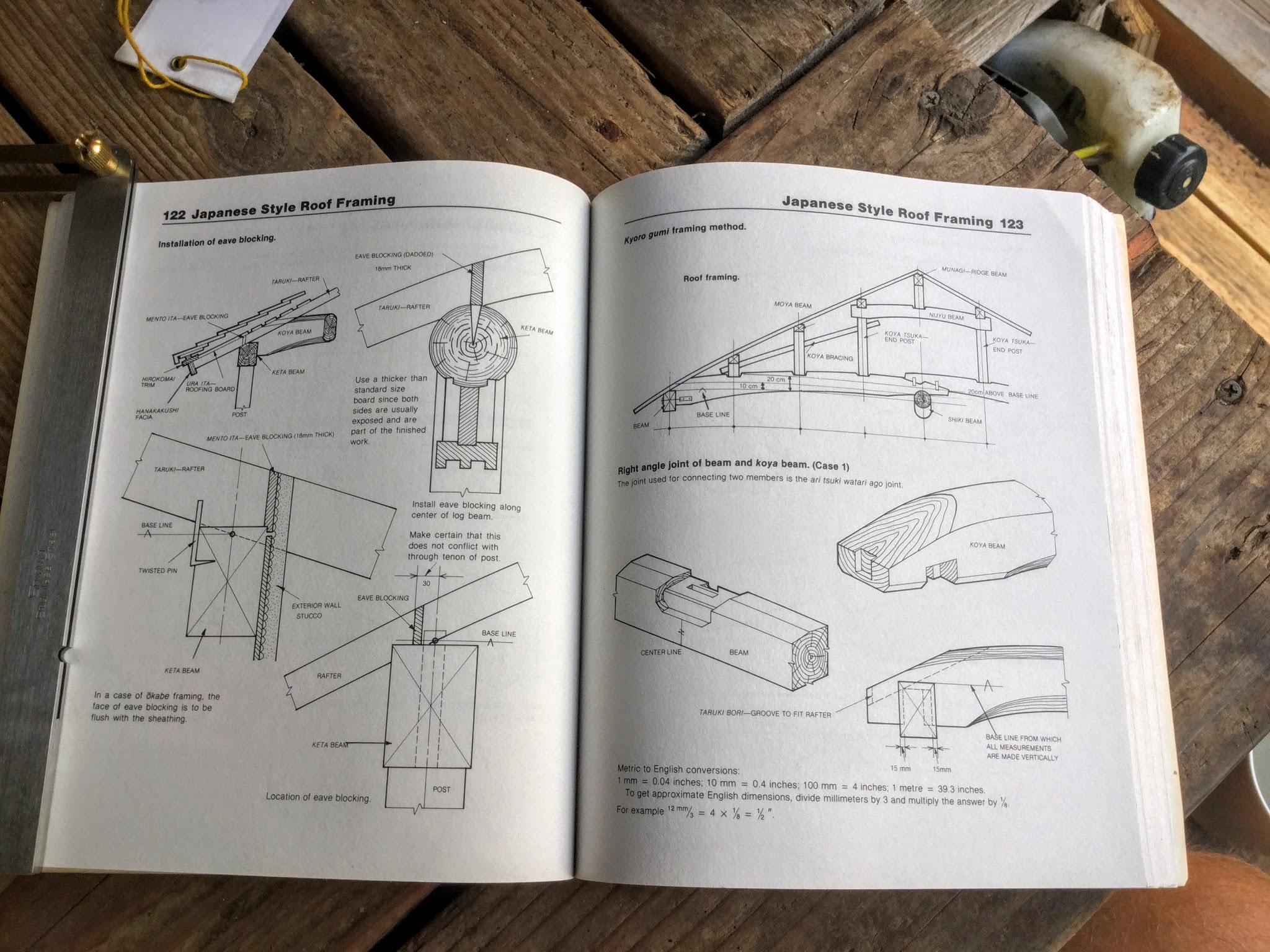


Lots of non-square framing up here.


Hip roof framing.


You can't avoid the hip roof if your studying this stuff, it's the iconic Japanese roof. Here in Hawaii, probably 80% of the roofs are hips and I don't think it's a coincidence.


The complex joinery at the corner, right where the hip rafter meets the uppermost wall beam/top plate. Nakahara offers a good, then a better option for joinery.


I want to try cutting this joint. Maybe Project Mayhem #10?


Here's a great jig for drawing proportional lines, followed by two options for using joinery at the gable roof ends.....


......followed by the quick and dirty, modern expedient solution, a length of threaded rod, haha.


Some classic and beautiful, some efficient and not so beautiful, but there is a lot here, over 200 pages of good stuff. There is much food for thought in this book.


Both "Japanese Joinery" and "Japanese Woodworking" are out of print, but they have been combined and re-released as "The Complete Japanese Joinery". Amazon has it, and I'd say it's a bargain. That said, if you are tight on space on your bookshelf, just get this one. It's good.


Thursday, September 10, 2015

Japanese carpentry books....."The Genius of Japanese Carpentry"


More books to share.....and a note.


These aren't meant to be reviews per se, but a brief glimpse of some content and photos. All books are good books, but it might be nice to have known which of these would've been most helpful to me as I am learning, particularly when dealing with a subject matter as obscure as Japanese carpentry. Support your library system and borrow first! The library system here in Hawaii isn't all that large, so I have only been able to borrow a few pertinent titles, but that has saved me a few buck right there. The other books I bought used through Amazon.com for about $60 (shipping included), about the cost of two nights of take-out dinners.....not that we do that sort of thing, haha. I know where the true value lies. The only knowledge wasted, is that which isn't shared.


So.


"The Genius of Japanese Carpentry ", by Azby Brown.


Courtesy of the Hawaiian state library system, this large format 2013 hardcover is a second edition color revision of Azby Brown's original 1995 work. The new edition has new material and revised text, as well as more pictures, color at that. I flipped through the original ages ago so I can't say for sure, but I suspect that this new printing would be an improvement. It's a very pretty book, very nice to look at. A coffee-table-y kind of book.


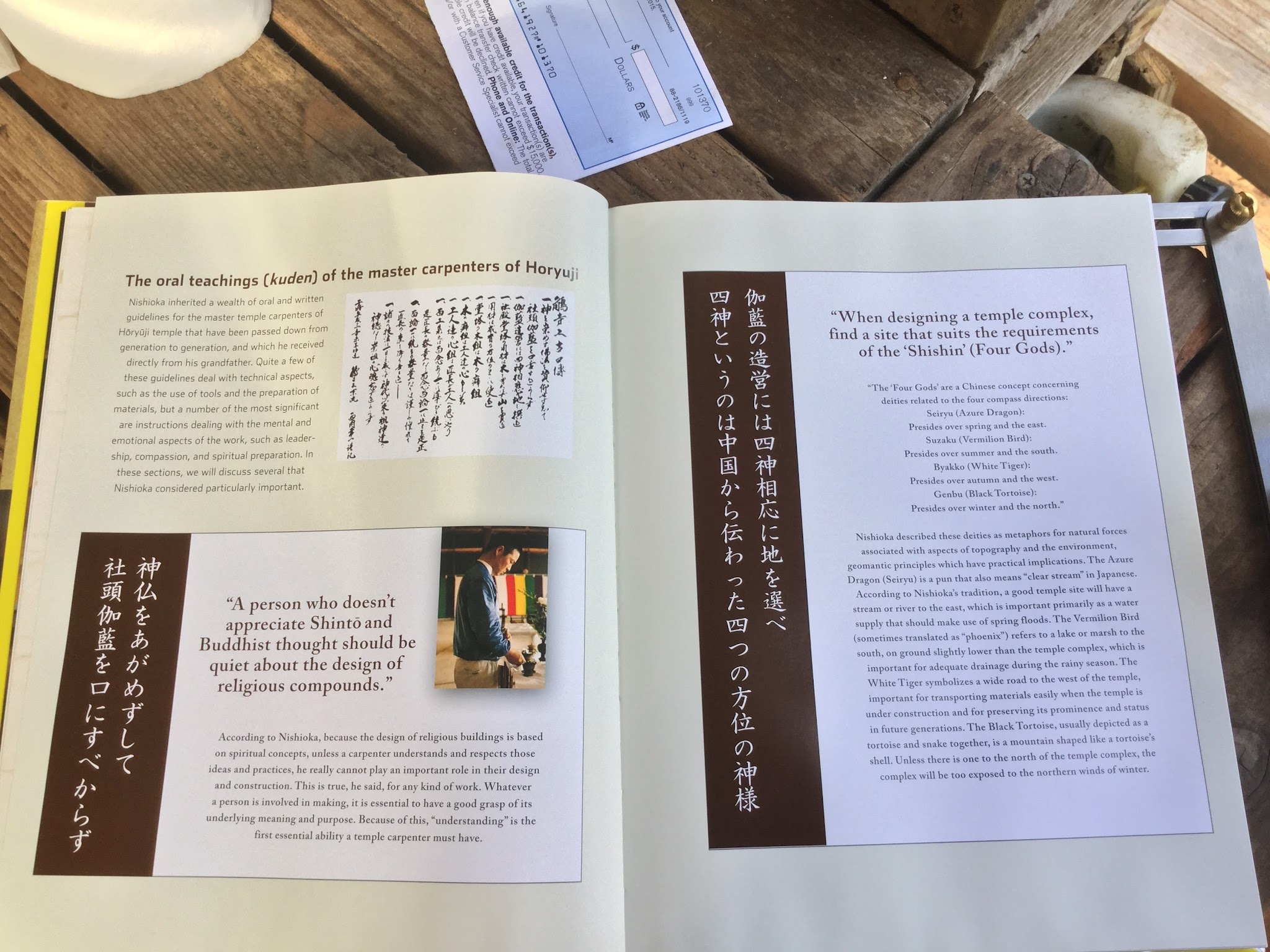
Interspersed throughout the book are little woodworking koans, quotes from the masters mouth, that are very good reading.


Really, this book is about a man who has dedicated his life to his craft, master carpenter Tsunekazu Nishimura.


Azby Brown was fortunate enough to spend much time over the course of numerous years observing and learning from this dedicated craftsman. This is a man who sees himself as an extension of a continual line of stewards, working to preserve these temples that are over a 1000 years old.


Yakushiji temple, was dedicated in 697 and finished in 698 (!!!), and then had to be dismantled and moved to a new location 20 years later. Just another benefit of joined timber construction, yes? Over the course of time, these structures get burned down during periods of civil unrest, or just fall out of favor. Buddhism loses it's once popular status and devotional money just isn't there anymore so buildings quickly degrade. I've read that small local temples were often completely disassembled and rebuilt every 20 years, but that would've been a local concern and responsibility.


Yakushiji is the main temple for an entire sect of Buddhism, so it was of a national importance. Burned down, rebuilt, redesigned, then ignored, it was evidently ready for a face-lift. The principles couldn't aquire government funding or they just wanted to keep things pure, but in any event, the rebuild has been financed through prayer donations. Very cool. Nishioka was part of the rebuilding of the East pagoda, then took detailed measurements to use in building an identical West pagoda, which burned to the ground 1000 years ago. He helped build the Golden Hall in the 70's (burned 500 years ago), and designed an entirely new lecture hall, a structure that wasn't completed until after his death. Talk about dedication.


The temple grounds and the buildings within are built to a grid design. The columns are proportional.


So, lots of temple design, but where's the woodworking part of the book?


Some rules of "proper" construction. Let's start with wood selection.


Trees grow differently, based on climactic and local conditions. North facing slopes promote slower/stronger growth. Trees that grow in warm lush valleys make for attractive wood, but tend to be weak structurally.


We get this one page. It's a short section, piques your interest, but that's all you get.


"Fabrication" shows some great shots of guys working.


Power tools are used, but are tucked away for pictures, haha. You can see the piles of shavings that you get from a power planer, everywhere. Hand tools are used for the finished surfaces.


Some really nice working stock. Huge logs! And the guy on the right.....that's how I feel when I'm doing layout. I think of this guy, I want to be like him.


Some REALLY scary power tool use.


And a guy showing just how fun it is to use a kanna. Really! When you get it figured out, it's a blast!


More carpentry knowledge.


Wood compresses as it ages, so you should allow for settling in the design phase.


So much for that chapter. That was it. Not many secrets in this book.


There is a brief chapter detailing some of the different tools used by the temple carpenters.


This was one of my favorites (not surprising, being the tool guy that I am) because we get a glimpse of the masters own tools, near as I can tell. I love the stacked tool boxes in the background.....this one for these chisels, that box has detail and moulding planes....this box is for yari-ganna.


You know what gives me the fuzzies? Most of my tools look old and well cared for, just like his. You see the evidence of use everywhere, and you know that every blade is sharp. His saws have been used, repaired, tuned and sharpened. The similarity is mostly because I try to buy decent (although not fancy), well used tools, and most of what I've learned so far has been from examining the best of what I've got.


Finally, some meat. "Making a joint".


The ubiquitous Koshikake kamatsuge, the stepped goose-neck splice, start to finish.


I love to see this guy's layout, and this instruction would've helped me greatly during our Project Mayhem #2.


You'll notice that he uses a big drill and spiral bit to remove the bulk of the waste from the mortice. Smart man.


The remainder of the book deals with the design and erection of the new picture hall.


I like this image, showing how the spliced timber sits in relation to the round post, being just enough to the side that it gains support from the post, but not in direct compression from the timbers that will set atop.


Also, we see that the rectangular beams are joined within the round posts, making round scribe work unnecessary. Practical.


There is some detail on the construction of the massive doors and sills.


Assuming that in time the 500 lb. door will sag, or that the sill will become worn, the parts and pieces have been made to be disassembled as reasonably as possible. I like that.


And the roof. Japanese temple roofs are incredibly complex, and this book goes into quite a bit of detail here.


The photo on right is one of my favorites, the long, graceful curve of the beam....so fine.


Another interesting detail pointed out here, is that the granite paving stones that surround the structure are layed on a levelled bed of primarily dry mortar mix.


Evidently, a ladle full of water is poured in the center, the stone is carefully placed and leveled, then water would be gently applied after all of the stones are set. A gentle mist would seep through the joints, and any remaining dry mortar would soon cure by absorbing moisture from the subsoil and ambient humidity. Fast, clean, and easy, I love it! I've done the dry cement thing when setting fence posts, but it never occurred to me to try the same thing when setting pavers.


After the ridge beam is placed, there is a traditional ceremony of honour and dedication.


This brief chapter describes the ceremony in some detail. The carpenters represent the more anamistic Shinto faith, dressing as priests to honour the forest spirits, then entreating them to leave the new temple peaceably and with great thanks.


After this, the true Buddhist priests enter to complete the dedication ceremony......then everyone involved goes off to a nice restaurant and have dinner and more than a few drinks. Carpenters are the same everywhere, haha.


I enjoyed reading this book, the pictures are beautiful and Azby Brown's writing is very enjoyable. That said, there is almost no practical carpentry here, under 10 pages in all. With this book, you are getting a glimpse into how an exclusive tradition has developed and been maintained for centuries, and there are certainly a few valuable pointers. It will give food for thought, but it's not going to help you build anything, cut the joinery or even use the tools.


It will definitely foster humility. These guys are amazing.