Showing posts with label designing for home. Show all posts

Wednesday, April 4, 2018

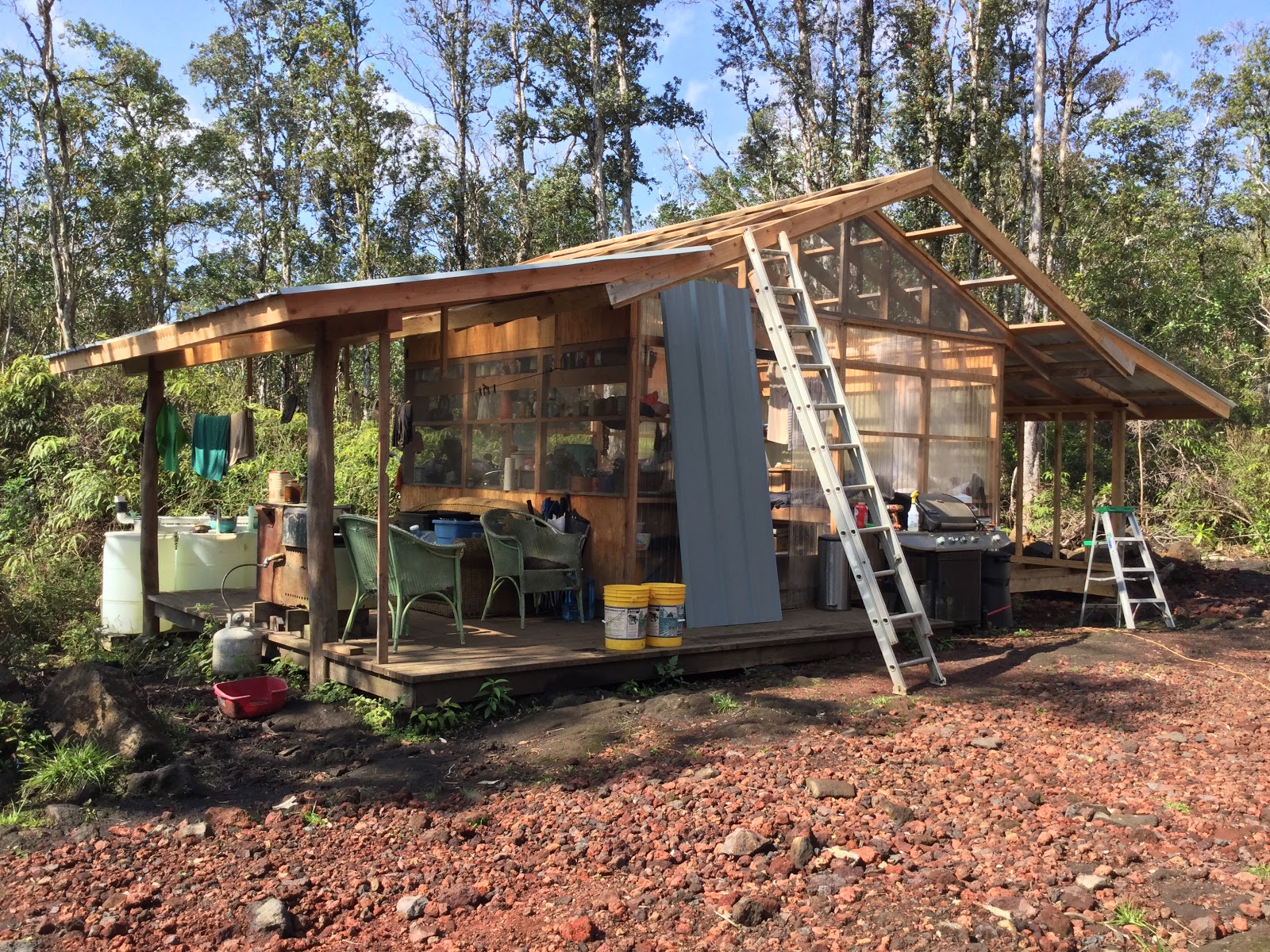
Sucker Hole or not......get the roof up quick!

Finding good, used building supplies here on the Big Island is a real trick. Yes, there is a Craigslist here, but after repeatedly seeing ads offering water soaked offcuts and the type of items that you'd normally be pulling out of the dumpster, all at next-to-new prices….you get burned out after a while. I guess it's a natural result of needing to have everylastthing shipped in at great expense that makes people think that this stuff is made out of gold, but every now and then you find some deals.

One of the metal roofing companies not far down the road has occasional scratch and dent items, and if your stars are all in alignment, they might actually have something at the exact time you have need. Don't count on it. Steel roof at $2/linear foot doesn't last long, so when you see it, grab it. All of it. I did, about six months back, in anticipation of getting a real roof over our heads, and that time is now. One slight problem; the rain just won't give me a break.


A Sucker Hole, for those of you who aren't familiar with the term, is a break in the cloud cover that makes you think that it could turn into a decent day…...then as soon as you get started on something good, the clouds return, usually with a vengeance. Hahahahahaha…..SUCKER!


The Ace Hardware store here sells two different colors of large tarp; grey/brown and white. Both tarps are made by the same company, but the white tarps have proven VASTLY superior in both finish and durability. Despite the grey/brown tarp having a moderately reflective grey surface to minimize heat gain, the white colored tarps stay markedly cooler, like 30% cooler, so says my IR temperature gun. Go figure….in any event, relying on ANY tarp to keep you and yours dry is something all done on faith. We've been lucky, to say the least, but crossing your fingers for over a year in a climate as rainy as this one will test anyone's faith.

Now if only it would stay sunny for a few days…..


An actual bedroom, lucky kid.


I've been sitting on that decent sized pile of metal roof for months, and now that I've finally framed in Ellie's new addition, it's time to put it to use. The rain stopped, it's time to go for it!


And, the gods being fickle (at best!).....the clouds came back. In force.


Ahhhhh Hubris, you've gotten me again.


Actually, I got everything buttoned up, just in the nick of time, but only minutes away from a serious deluge. And only a couple of leaks, haha. It beats the tarp though. Next thing to do is gutters. At least now that it's raining again, I can get back to work on my fuigo.

It never ends, this building stuff.


Thursday, April 7, 2016

Digging in the dirt — Feb and March 2016


We (Renee mostly, let's be honest here) have been doing a lot of digging since we bought this piece of land, but you know who's *REALLY* good at digging?


Pigs.

Wild pigs are in abundance, as I'm sure that I've mentioned a time or two, and the evidence of their passing through an area is hard to miss.


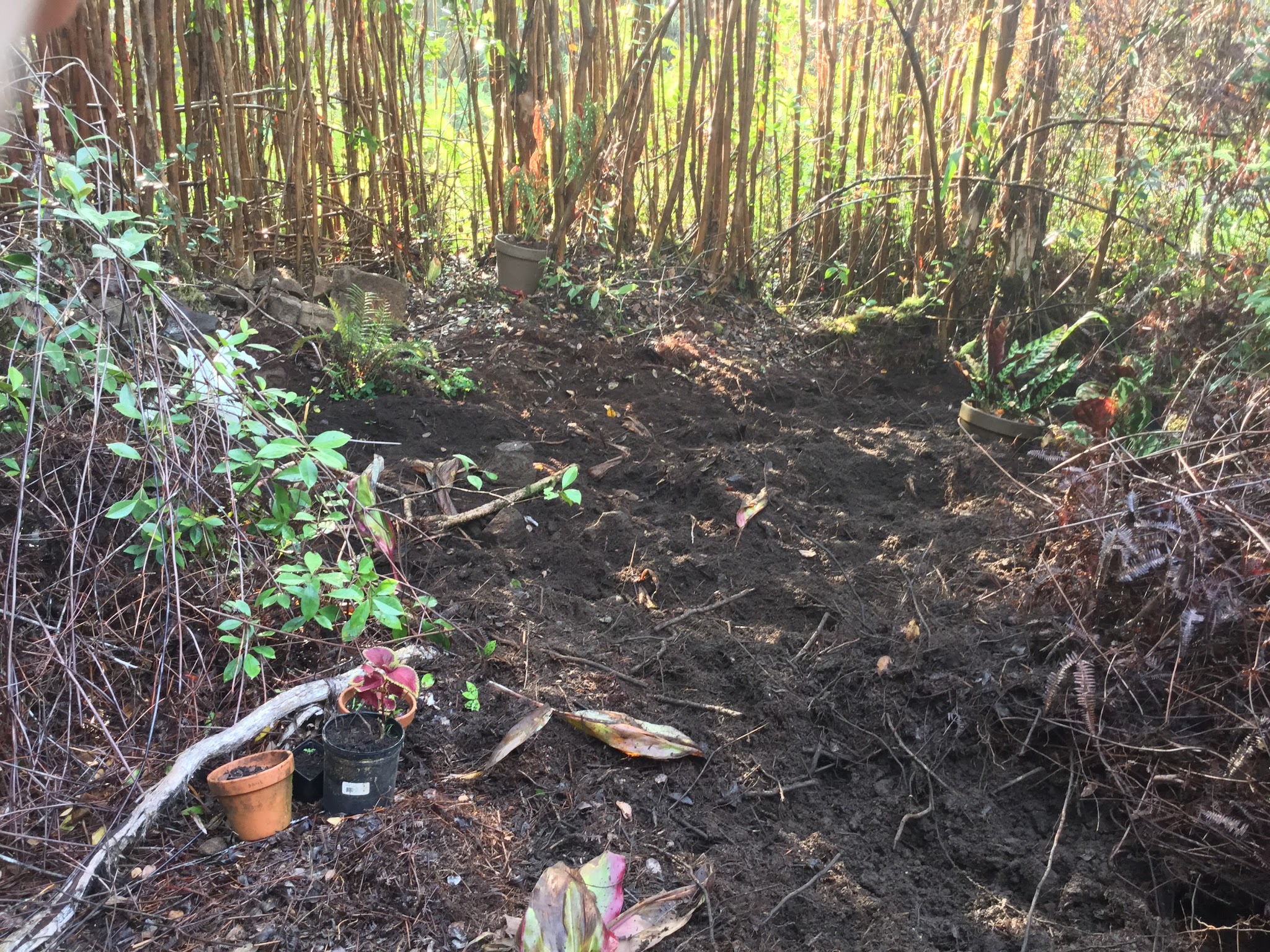
This area looks like it's been gone over with a rototiller. Maybe it would be a good spot for a new garden?


Unfortunately, they also found something interesting in Renee's shade garden.


Trampled and dug through but, as tasty forage is abundant and most of the plants are purely ornamental, the pigs left most of the plantings alone. We have been expecting this sort of thing to be a common occurrence, but nonetheless this serves as a good wakeup call, a thing to keep in mind for our edible endeavors.


Many families here keep a pig or two, and more and more it's feeling like a practical decision. We generate very little household waste, but despite a lifetime habit of composting vegetable matter and recycling what we can, there always remains the question of dealing with non-veg materials, meat scraps and the like. It's highly unlikely that we will go vegan anytime soon (like...never), and a pig is happy to turn that nasty garbage into protein and manure. Pen them into a restricted area and they will also do an admirably thorough job of tilling the soil, as we have been reminded.


Pigs....the garden tool that you eat.


While thinking of pens and enclosures, I started putting a bit of the rampant tangle of Guava to a more directed use. It's my intent to lay the guava as a hedge row in the English tradition, using its resilience and vigorous nature to help define the property boundaries, but this day was more of a fun start.


This area is the only level spot large enough to fit our two (small) cars and it's proximal to the road. After removing the guava, we'll actually have an area to park! First though, the stumps and roots must be removed.


A lashed-stick tripod and hand winch make the task a bit easier than tearing away with a pickaxe alone. I pull the root mass upward, then work around the perimeter, severing the remaining roots using a hatchet and knife until the clump is free. My saving grace is that the soil in this area is fairly thin with lava sheet below, and the guava is a shallow rooting plant, here at least. 30 minutes? Then on to the next.....and the next.....and.....


Every now and then our neighbor Robert Sr. drives by, giving us crazy haoles mildly incredulous looks and offering a tepid wave. After watching me take the better part of a week to clear a 10' x 20', he says he's had enough and that watching me work like this is making HIM tired. Crazy haoles! He fires up his old Case backhoe, then finishes stripping off our parking spot in about 15 minutes flat, haha.


After pulling out some of the loose lava for Renee to play with, we've got the beginnings of a parking lot. Thanks Robert!


Having neighbors like Robert Sr. is one of the reasons why I like this part of Hawaii. He's a grouchy old hawaiian dude and not overly friendly to strangers. Opposite his driveway is a derelict school bus of his that acts as a local landmark, and from what little bit of his property you can see from the road, it seems to consist of a couple of junk cars and an old shack, all of which is almost entirely hidden underneath 20 years of jungle growth. The cluttered mess and gruff demeanor are a front. He plants starfruit that are hugely prolific, right next to the road so that neighbors can share the bounty. He drives old cars because only fools drive new ones that are troublesome for the owner to fix. Likewise, his old backhoe gets worked one periodically by Robert himself, just enough to keep it functional. He saves his money, only spending when necessary. My kinda guy.


Well, a couple days later, what should I find but this?


Robert put Renee in the driver's seat, and told her to have fun. She did, and quickly roughed out another garden bed, then dug up more stone for the remaining wall.


Renee says "Wow! That was awesome! We should get one of these things!


Haha! Bingo! Just what I was waiting for! I had been following the Big Island backhoe and excavator market for the last 4 months, and it just so happened......


And Renee is right. Backhoe's ARE fun!


I must admit to feeling a bit conflicted in buying/using heavy equipment to aid us in our endeavors. Foolish perhaps, but.....


Clearing the land is a large undertaking. The general means of doing this is tohire a huge bulldozer to strip off every bit of living matter, then drag a 3' long tooth through the lava to break things up. The resultant rubble then gets driven over repeatedly until the stones crushed into an even size, then spread around to contour the site. Finally, it all gets covered up with imported topsoil so that stuff can grow, usually a grassy lawn. I think I could safely say that a lawn would be the LAST thing that we want to surround ourselves by, to look at every day.


We pass by this neighbor on our little side road, and we've been able to watch as he developes this property.


Not too bad, as these things go. He had a smaller bulldozer brought in to do the work, taking about one weeks time. He left some trees for visual interest (the permaculture guys here call this "native landscaping") and I'm sure that it will continue to improve in the coming years. Still, wherever the bulldozer goes, the soil disappears. That thin brown patch is all that's left of the soil, the rest of the place is bare, gray stone.


In some areas, the amount of topsoil is insignificant. This stretch of road I cut is 100' long and runs atop an old lava tube. Zero soil here.


Other spots however.....


Large areas of our place have these fields, full of climbing Aluhe fern.


The soil here is so deep, 4-wheel drive would've been a nice option for the backhoe. 2-3' deep with some chunks of old lava thrown into the mix, rich, black soil. At least with a backhoe, you never get stuck, haha.


So my quandary? Why would anyone NOT want to use bigger tools, get the work done with dramatically less effort? Back in the old days, a poor farmer would have to clear his entire field, carved from the forest itself, using only an axe, pick, and shovel. Of course, as soon as he could afford it, he bought a plow-horse, a team of oxen if he was doing really well. There is always work to do, and it's just natural to shift the burden to other things. God knows, I've got plenty of other things to occupy my time. The days are almost NEVER long enough, and none of us know how much time we really have.


My issue is with scale. Bigger tools mean bigger projects, more time, and more expense. When your tools are a shovel and a hatchet, you build within the inherent restraint of the tools. My original intent was to clear a small spot from the jungle, then build a quick shelter. My enthusiasm for digging stumps from the ground is not boundless, and at the rate I've been going, the time required to get to the back of our 1045' deep property would be likely measured in years. Renee is patient, but even she has limits. So yeah, the time thing is important too, but again, much of this is about scale of work.


Small. Small is good. Using just a shovel and pick, I can build a very cute and practical garden bed. Big gardens are a PITA, small pocket gardens are fun. I'd rather have 10 small gardens than one large one. Likewise, are homes. Small houses are great, cheap and funky. A big house (and mortgage!) is a quick route to an unhappy life. I'm usually more enchanted by a cute garden shed than a pole barn.


Enter Sjovel (he's not Swedish but, what the hell, it's a good name for a guy who digs holes). 10 days of digging has gotten me 1/3 of the way into the property and, while its far from being a road that you could actually drive on, at least it gives access. Another week of work should put me in the general vicinity of where we would like to begin building. Along the way, I've been collecting Ohia to use for future construction and a difficult proposition I had been dwelling on for ages, moving SUPER heavy logs, has been solved with the stroke of a pen. Making new garden spots will be a breeze.


The problem is that it's too easy. I need to reign myself in periodically, to remind myself that the trail should be as narrow as physically possible, to not dig up every rock I can find, and not pull up every guava within reach (and it's easy, let me tell you, ripping out the guava). See, every patch of Guava that gets torn out, every clump of Aluhe that I rip up, it all gets replaced by something else. All garden spots need a cover crop ASAP, otherwise there are a multitude of nasty weeds that will fill that void. This virgin land has very few weeds, so few that you can infer their introduction based on how far the new growth is from the parent stock next door. I think of tearing up the land as an obligation, like having children or adopting a pet. A lifetime contract of sorts. A cleared field needs to be worked, fed and nurtured, else it runs amuck and goes to hell.


And a bigger house would be nice, but a larger structure takes more time and money to build. A small house is efficient to build, easier keep warm or cool, and is more comfortable to be in. To keep things in perspective, 900 sq/ft is getting too big for our liking, so it's not like we are talking about building a mansion or anything, but....when the limiting function changes from what one man can lift and carry, into the monetary restrictions on buying big pieces of lumber, it's something to think about. How much of your life are you willing to trade for a larger house? Me? Not much.


The garden might get bigger though.


Sunday, February 7, 2016

January progress.....a bit, anyways.


Perhaps it's my Midwestern blood, but wintertime is still a period of hibernation for me. This, despite our now living in Hawaii with its tropical climate and long(er) day length. At least that's what I'm telling myself.....surely that's a good excuse for my lack of progress on the home-building front?


"So.....what have you guys been up to, anyways?"


—*NOTE TO SELF*—

When buying salvaged roofing material, try not to choose the stuff that has 20-odd layers of old paint on it, no matter how cheap it may be. Remember and acknowledge how obsessive you can get when picking old chips of peeling paint from a surface.


The wire wheel/grinder combo might be faster than going it all by hand power, but not by too much.


"But wait......I thought that you guys didn't have electricity?!?"


Please bear witness to our emergency generator. Not only is it huge and inefficient, it's also one of the most expensive ways to create watts, haha.


The jumper cables run into a tote, inside of which is a deep cycle battery that acts as a buffer for heavy surge loads, and from that, to moderately cheap 2000 watt sine wave inverter.


The inverter is mounted to a piece of plywood, keeping both the inverter and battery from shifting around, and elevating everything from any acid spills or inadvertently accumulated rainwater. In the picture, you are looking at the side of the inverter, that silver thing under my multi-meter. The silver box looks pretty boring, but that's where the magic happens, Direct current (DC @12 volts) being altered into its Alternating (AC @120 volts) wave form.


The whole setup is pretty ghetto, but that's how we roll. It works, though I try to use it as little as possible, it being a severe impediment to my being able to brag about how we don't need their stinking electricity anyhow, thank you very much....haha.


There's more fun where that came from.


The beautiful Renee has been doing the real work for the last month, finding the perfect place to put all of the lava she digs up.


The Okinawan sweet potatoes love it here.


Paths and terraces.


It's a little hard to discern, but she has been weaving the guava whips into a sort of living fence. Soon the thin shoots will be sending out new vertical growth, turning this surface into a wall of solid green.


The walls surround an area of dappled sunlight, perfect for growing some of the more shade tolerant plants.


She weaves the stiff Aluhe fern stems, wrapping ever more of the thin Guava shoots, around and around......


.....hangs them in the trees, then tucks in an Orchid (actually vice-versa, but you get the gist).


Homemade planters for epiphytes, pretty cool.


I've been incrementally cutting my way through the tangles of Guava, swinging the chainsaw in an arc roughly 6" above the ground.


It doesn't look like much, but this area, only 20' to a side, created a stack of Guava nearly the height of my head.


We separate the shoots by size, smallest to large, then cutting off the branched top, to be composted. I see an army of stick chairs here....


...or maybe a stick house?


We are roofing the structure with clear polycarbonate sheets in the interest of keeping the weight as low as possible.


It's also cool, because when you lie on your back and look to the sky, it's as near a thing as having no roof at all.


Initially, I have screwed the intersecting pieces together. Then, after the branches have had a bit of time to shrink some, I lash things tight, using lengths of nylon seine twine. Screws alone won't suffice for long, the forces of the bending and shrinking sticks being enough to snap the stiff deck screws here and there. The twine square lashing stiffened things up remarkably, tying the structure into a springy and resilient whole. I like that.


What maybe doesn't show in the photo, is that there are approximately 10 bazillion intersecting branches in this glorified 12' x 23' gazebo, and many of the lashing are stacked one atop the other. Access gets awfully tight in spots, so progress is slow. I try to tie each lashing perfectly, and despite having already done this *many* times already, I still occasionally take one apart that just doesn't look right.


Aside from the time involved in doing a good job, there is also the concern over UV degradation, bring roofed with clear panels and all. The lashing need to be coated with something, paint most likely, but I can already see that as another one of those projects that gets delayed too long. The proper time to coat the lash is...immediately!


You also might notice that I'm using unpeeled logs. Initially, this was to be just a quick way to get a roof over my head, a dry spot to work. Famous last words, right? I started out peeling the sticks, stripping them of their bark, but being in somewhat of a hurry (ie: lazy), I swiftly transitioned into using the stock just as it came, bark and all. Within just days, I noticed something interesting though. The sticks that had been peeled were immediately lunched by the ferocious powder post beetles that we've got here, whereas the unpeeled stuff remains untouched to this day. The bark and leaves of this Guava contain so many tannins, nobody wants to eat it. Working the stuff instantly turns steel tools black, and makes your clothing look as though you've been crawling around under your car, dropping the transmission or something. This stuff will make a great ebonizing, purple/black dye....That's for another day though.


So what have I *really* been doing?


Mostly sitting on my ass, filling page upon page in my "Book of bad ideas".


See, the real problem here is that I've got too many options. I'm extremely adept at making the most of little, but now that most of the typical restraints have been lifted, I'm at a loss for direction. We have money, and we have space, but no map. Each route has its attractions, particularly so, as our standards are very low, haha...... Or are they?


To be honest, I'm finding that building with sticks and branches is....unfulfilling. Renee has forbidden me from tearing the "stickhaus" down and starting anew, but I swear....given half a chance....


I'm spoiled, I admit it, but working on a project that doesn't fully resonate within, it's draining. Why don't I build what I REALLY want to build? Well, what I've been obsessing about, apparently it hasn't been done before, at least according to Google. I consider myself fairly adept at sifting through multiple search term queries, and I know that the truth is out there, but I'm not finding much inspiration.


What I want to build is a system, something that I've touched on before, a modular format, prefab, portable when need be, type of small structure design. Individual components must be portable by one strong individual or two, if your hermit has a friend. The standard size of sheet goods is 4'x8', too big a fit for most cars, so smaller multiples are required. I want it to look nice too, so I'm intending to use as much "real" wood as possible, only resorting to plywood and it's like if it's worth enduring its unfriendly working qualities.


A small and efficient shelter, low cost, and not too difficult for the average person to build. Let it be nice to look at as well, and you might be seeing them tucked into cozy secret corners, without drawing too much fuss by the neighbors (and authorities). Not a "tiny" treasure McMansion, nor a 1970's Swedish erector set house. Legos color scheme is too bright, so no love there either.


There is no way that I am the first here, but really.....

Saturday, October 31, 2015

Weekend progress


Renee, being the hard working girl that she is, has a "real" job that occupies here throughout the week, has her crunching numbers, strings of crazy long gene sequences AND teaching a class and students as well. Thank god she can relax and take things easy on the weekend.


Renee is also like a little excavator in human form, and I don't know where she finds the energy (She's nuclear powered, I suspect).


On Saturday, she had a vision, then promptly started to make it real.


Or maybe she just couldn't stop digging. The woman is, seriously, just a digging maniac. Ellie is searching for leaves, and the neighbors dog is searching for Ellie.


We've got soil in abundance, lying all rich, loose and crumbly atop the lava. The Aluhe ferns that were here before, blanketed the area with leaves and other decomposing matter for the last few hundred years, eventually producing this wonderful soil. Soil is truly an amazing resource, something that too many of us take for granted, but not us. We are conserving every bit that we can. After living here for nearly a year, we have seen just how rare this type of earth is. More common is to have the barest skin of dirt lying on top of large sheets of lava. This is the first place that we've been where you can actually use a shovel.


It is common here to ask, "How is your land? Is there soil?"


Ellie has been making birds from various leaves found in the forest. This one must be a cardinal, judging from the crest on its head (the next step will be working on camera focus :-)


Our baby cardinal friend lives here somewhere, and it's my hope that if we would start laying out some food, we'd see him again. None of the cardinals are about, so there must be some better food elsewhere.


Dogs and dirt.....what's the attraction?


I'd say that she is hunting up a gopher, but I'm pretty sure that we don't have them here in Hawaii, certainly not on this side of the island. She's just loving the dirt, digging and helping out.


This is the place on Sunday.


She dug out a big pocket of soil, separated out the jumbled chunks of lava, then layed a solid base for a parking area. She's a monster.


This entire island we live on, soil, trees, food, animals, everything that we know and see every day....it's just a skin atop rock. Everywhere, the entire world is like that, but it's something that we've forgotten, most places. This miniscule layer is all that we have, that gives us life and sustains us. The big island of Hawaii is new, geologically speaking, and here we are reminded constantly that life is a short and wonderful thing.


The soil is life, and the lava underneath is the origin, the beginning. These volcanoes erupt continually, lava breaking free onto the surface and covering everything, then quieting down again for 10 years...100 years.... 1,000 years....


When the lava flows, it often covers, but doesn't always scour the earth. It buries. So what we are seeing as we dig our little garden bed, is evidence of a millenia of events. The lava comes, then life gradually colonizes. The native Ohia trees are some of the first to return, having evolved to be able to live in thin soil, putting out thin strands and clumps of aerial roots to aid them in obtaining the water they need, water from the air itself. Eventually you get a mature Ohia forest, which is what we have now. Then the lava returns, covers it all, and the cycle begins again.


Our little garden is thin lava, broken by time, atop more lava which is also broken, atop probably more lava. There have been many different lava flows here, and there will be more.....probably. The island is still moving, and as it drifts further from the thin spot on the Earth's mantle that caused the island to form in the first place, the island will cease to grow.


Anyways......dirt and rocks. Lots of dirt. Renee is in heaven.


She has exposed two ridges of lava, and right down the center, she is seeing in her mind a waterfall cascade of steps, the early stages of which you can see here, from the side.


The broken lava is an absolute joy to work with, coming in a wealth of different shapes, many flat surfaces, and some with square corners.


If you've done rock work before, you know that square corners are like gold, something to be saved and hoarded for the future. The rock above isn't a corner per se, but is even more unusual, shaped like an inverted "L". It's also blue in color. Renee is using blue and silver stones for the steps, placing the red and gray rock elsewhere.


And up above, she planted some Okinawan sweet potato runners.


This is a new favorite of mine, though I've never been a fan of sweet potatoes. This plant is gardener's ease personified, just drop it on the ground, place a few handfuls of dirt here and there on the runner stem and that's it. It will soon grow and spread everywhere that you let it, and it also works well as a cover crop/living mulch. The young greens and shoots are eaten steamed, and taste somewhat similar to spinach, minus that uncomfortable oxalic acid feel in the mouth. VERY tasty, both the greens and the purple fleshed tuber.


Part of being a good gardener (which I am emphatically NOT), is knowing what grows where. This is a new climate, and to be rigid in our thinking and demand that all of our old favorites be grown in the garden, well, that's just absurd. Normal potatoes, lettuce, tomatos, peas....there is a long list of what doesn't like to grow here, primarily due to the high rainfall. There is an entire new world of plants that DO love it here though, and "right living" comes from that understanding. Effect change where you can.....don't try change the plants (because they won't listen), change your diet instead.


I have a different set of time constraints than my wife, so I get to work on the new place most every day. I start out as I usually do, by clearing the building site of undergrowth, then piling materials dead in the middle where they are guaranteed to be underfoot, whether I need them or not.


I ran a stringline around a rough perimeter going from tree to tree at an arbitrary height above grade. The slope right here is about 1/10 and, where the patch of ground that Renee has been working has lots of soil, this spot has essentially none. That's why I chose it. It's a horrible spot to grow things. Keep life where it is most happy.


Raise the camera a bit, and the strings come into alignment.


The lines are level, but the camera is not.


Some of you might recognize some joinery here.


So honest to God, I drive myself crazy. This is supposed to be a simple elevated platform, a level surface from which to work, and a basic tin roof. I'm not even planning for walls. 80% of the materials are ugly and salvaged and I'm planning on using guava sticks for the roof members. A long service life is not a consideration, and take-apart modular is a minor design theme. I finally caved and bought a screwgun, so screws are here, nails are here, and I should just bang this out, right?


To all of you who know me.....I can hear you. Yeah, right, sure.


It starts with a simple splice......


This lumberyard 2x6 would feel so much nicer in the hand if it were planed....


Height above grade will be over 36" at the most likely side of approach, so maybe if the nicer sticks were used on that side, maybe introduce some curved elements......


And so it goes. I can't help myself. People kindly (and sometimes NOT so kindly, haha) call me a perfectionist, but it's not true. I'm an incrementalist. Perfection is an illusion that can never be attained, but nearly everything can be made just *sliiigghtly* better.


Naturally, this drives others crazy too.


I chose a site with a minimum of existing growth because I don't want to disturb the area any more than necessary but, because the guava is:

  • A) Considered a pernicious invasive that everyone wants to kill anyway, and....
  • B) is also a lively and resilient growing machine, that....

..... I start envisioning using the few existing trees as the foundation posts of the structure and extending up to serve as supports for the roof as well. These things are so tough, that I fully expect them to bounce right back, sending out new lateral growth, despite being viciously "topped". And if they die.....well, I was going to cut them down anyway.


But what if they DO live? Wouldn't it be cool if the structure was as "alive" as possible? Not only is the guava a vigorous and hardy tree, it's also enthusiastically innosuculate, meaning that it is self-grafting. If you want to weave a living wall, there would be few better choices of plant to begin with.


In any event, while I entertain grand thoughts, I also rig a tarp overhead, to keep the tools dry.


The sumi ink that I'm using for layout works great on damp lumber, but if the stick is actually wet, the ink just runs and bleeds. If I swipe the area with a rag, then lay down a very fine line, the ink will set enough to hold, but it's not the same as say, marking on dry wood. FYI, for those of you working in the rain. Fresh cut green wood, no problem. Compared to pencil, there still is no comparison. A pencil only works well on dry lumber, and it's been nearly 6 months since I've touched one for carpentry. I used one the other day...for about 2 seconds. How the hell do you cut to such a fat f***ing line, haha?!


I also built a new sharpening station.


Haha.....nice, huh?! I miss using good stones though. My standards are currently low.