Showing posts with label Toishi. Show all posts

Monday, June 30, 2014

Comparing two Kings, (waterstones, that is)....


Another eBay fail......"I've lost my Mojo!!"

Here's the original description.

Offered for purchase
ONE
Old Natural Very Fine White Sharpening Stone. Measuring 8 1/16" long, 2 9/16" wide, 1 1/8" thick, and this weighs 1 lb 14 oz unboxed. Not signed as to the maker. This is in decent shape, the only cleaning I did was to give it a quick wash with soap and water. There are some chips on the corners and a few small ones on the edges. There is some rust staining on the sides and a few on the top. The one face has a wee bit of a dish end to end, the other one looks fairly straight. There are a few light dings on the face but nothing too bad. This one ain't perfect but it sure is old. A decent collectible old sharpening stone for sure!

Not a bad description, compared to most of what you see on eBay. Natural, white, and old...... I was hoping for a Hindustan or maybe a Lily White Arkansas/Washita.
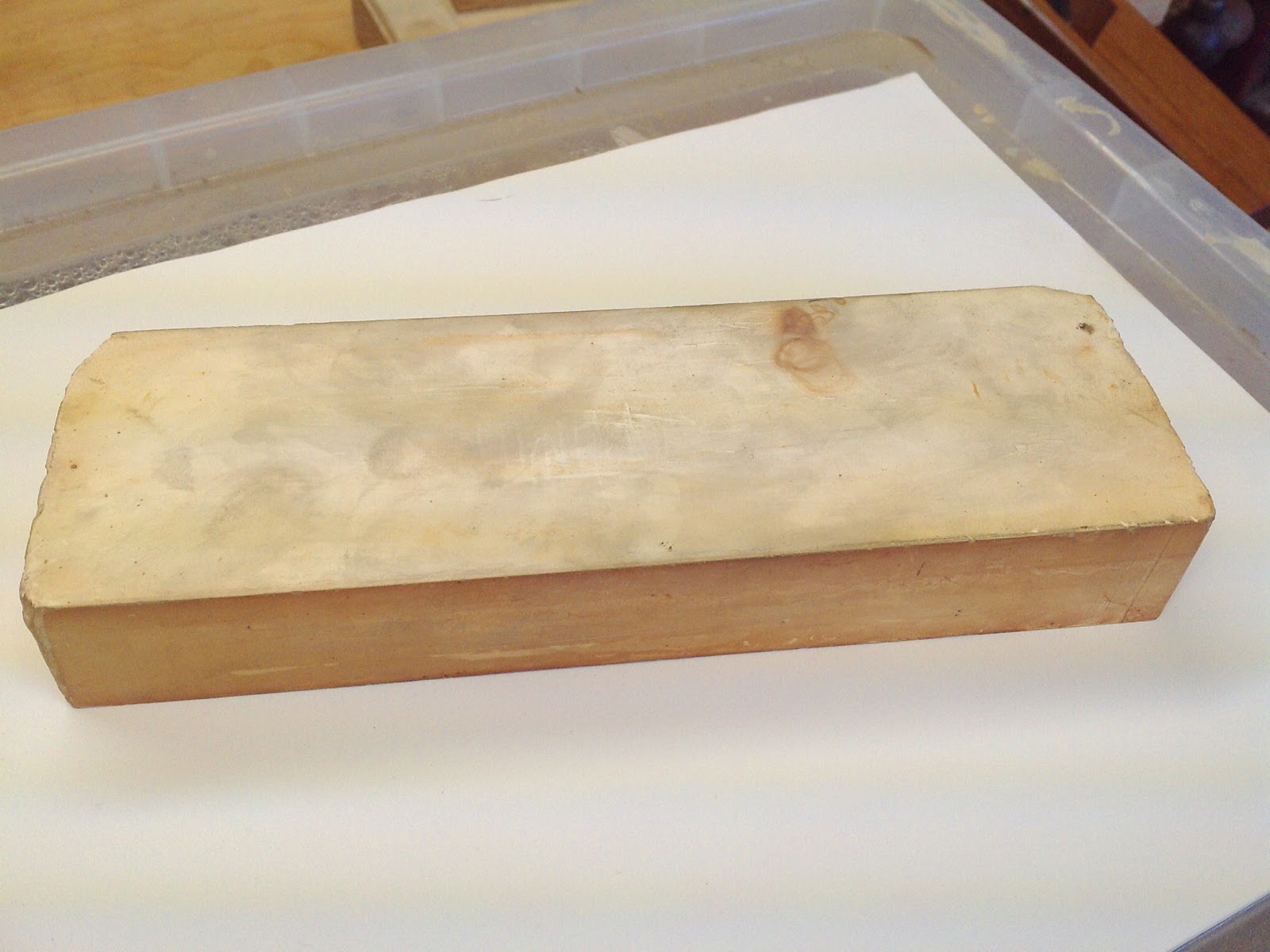


Not natural, white, or old. Well, it's actually pretty  white....for a sharpening stone. 

So what is this thing? 

The size is a direct match to my "King" brand Deluxe #1000 grit.


The corner shows some raised vertical lines, extrusion marks or molding imperfections.


Faint horizontal cracks, signs of shrinkage (There was shrinkage!!!). Again, sure signs of a man-made stone.


I sent the photos to the seller, but he still maintains that it is an old, natural sharpening stone. He did begrudgingly offer a refund, but I would need to open a complaint case with eBay/PayPal to get my shipping refunded...... How do you get  a 100% rating on over 11,000 tool sales, and not learn something about old sharpening stones?

Well, enough bitching.... my curiosity got the better of me, lets see what this thing will do!


What's a big Norton oilstone good for? Flattening waterstones, haha!


****
Actually, they work fine for the simple carbon steel used for old western tools. I support the theory that tool steel hardness matches the available sharpening technology. You can achieve an Rc-64 hardness with simple high carbon steel, but it will be brittle and you won't be able to easily sharpen it using traditional oilstones. To draw the temper down to a more realistic Rc-56/58 is practical. The blade become more tough, resilient to impact shock, and is easily sharpened. What good is a super hard tool that you can't sharpen?

My point is that it's not that they didn't know how to make hard steel blades, back in the day. To the contrary, it's that they were smart enough not to. Your average 18th century carpenter is going to be pretty pissed-off getting a blade that shatters the first time he hits a knot in the board he's planing!

Culturally, we have the unfortunate tendency to discount and discredit the knowledge of the past, assuming that "They just didn't know better". Don't get me wrong....I don't assume that everything old is better than the new stuff. I think that it is very important to study "HOW" things were done, because the "WHY" is still pertinent today. If you assume that you're the only smart guy in the room, it makes it hard to learn anything new.

****

Where were we? Oh yeah.....


This face I flattened completely. Underneath the old, soiled surface is an extremely smooth, ivory white (not pink, like in my crappy photo) material, most likely of an aluminum oxide composition. Some staining remains.


This big naga-dai (big-body) kanna has been sitting here for too long. This is the equivalent to a western jointer plane, like a Stanley #7.


Before


After 15 seconds or so. 
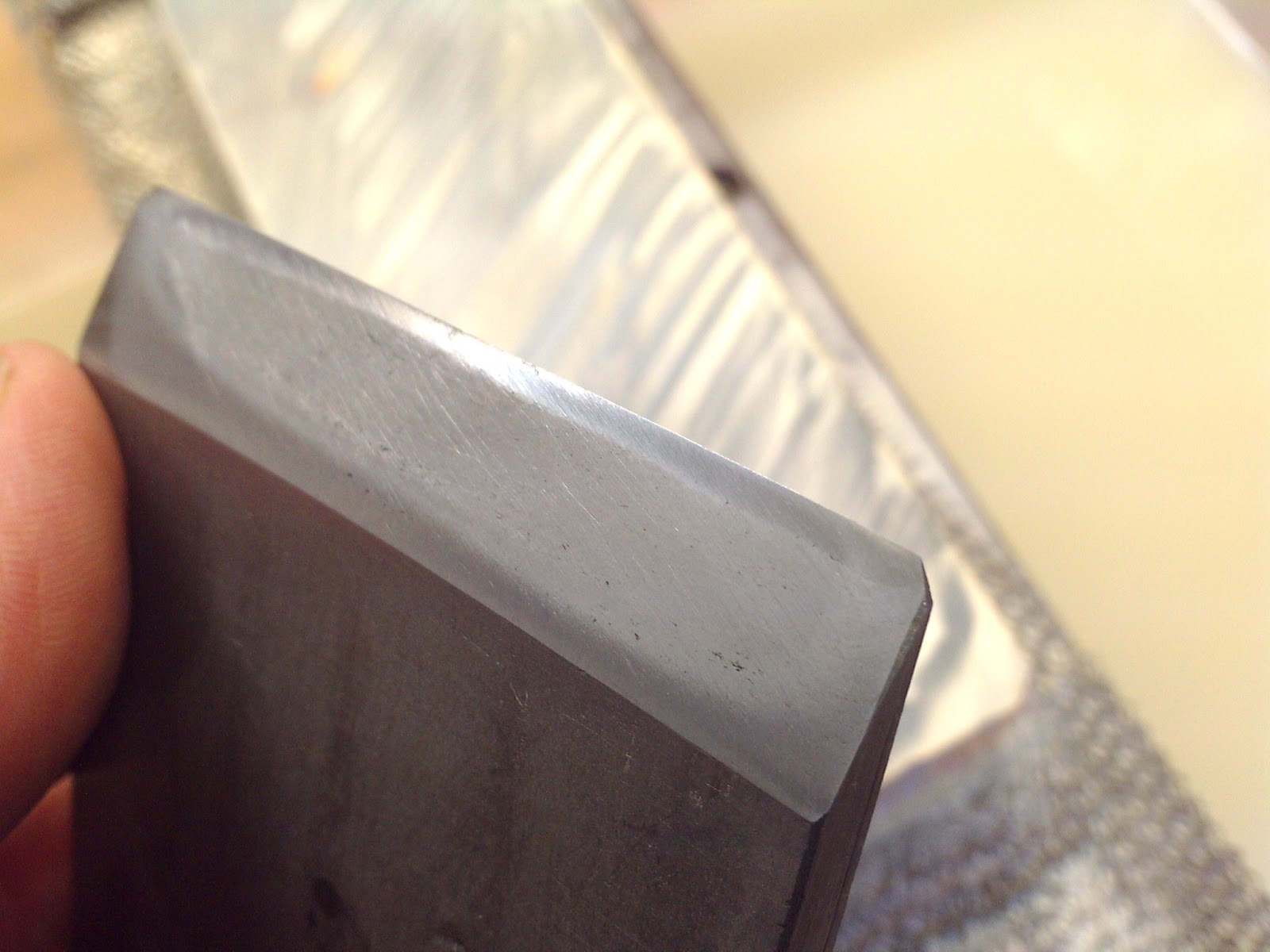

I'm just looking at scratch patterns here, not trying to actually sharpen, OK?

The stone feels only slightly gritty/coarse, different from my King #1000 grit, smoother and moderately muddy. Fast-ish.


Now to compare it to what I do know.....


The suehiro #3000 is way finer.


The King #1000 is..... different.


I run this one so that the scratch pattern runs parallel to the edge....

.....then a few swipes on the new stone to see how the scratches compare. The white stone scratch pattern runs about 50° here, with the #1000 visible underneath and parallel to the edge.


They look about the same to my eye. The character of the scratches looks slightly different, though.

Now I do a side-by-side comparison. The red #1000 grit on the right, the white stone on the left.


While I would guess that the new white colored stone is close to a #1000 grit, the scratches have a different look to them. The red #1000 (right) shows lots of coarse marks that extend to the hard steel. The scratches from the white stone don't extend into the steel so much, indicative of a softer abrasive, perhaps?

Artificial waterstones are composed of a range of grit sizes to achieve a nominal finish number. The old-school Kings use a broad range of grit sizes because, for 80% of users, you just want something that is fast, but still inexpensive. The vast majority of users are sharpening knives, and these stones will give a good serviceable edge. Sharp, yet toothy enough for meat and soft veggies. There is also the thought that big scratches and little scratches can be beneficial arrangement, resulting in a more durable edge. Interesting, to be sure.

The white stone may have more finely graded particles but it feels faster than the red, on this relatively hard blade. One thing WAS apparent...... This white stone is much more resistant to dishing than the King Deluxe.

The King Deluxe #1000 grit was pretty dished after relatively light use, although this blade was fairly hard.


The gap measured 0.06" over 8" -or- 0.15mm over 205mm, take your pick.


This is the white stone, zoomed in to see the gap. Even though it saw much more use, the gap measured a more reasonable 0.0015" over 8" (0.038mm over 205mm). 


The amount of dishing (or lack thereof), is interesting, and I was quite surprised. This stone is rather muddy, and felt a bit like my suehiro Rika #5000, which tends to dish in use. I searched many different offerings of waterstones, and based on the size, color, and character of this stone, I'm gonna guess that it's a King Hyper #1000. The Hyper stones have a harder composition and evidently added a different diamond-like abrasive to their mix, to be more effective when sharpening hard stainless steel knives.

I can't complain too much...... The stone was cheap, and it's a decent stone, works well, all that. An old, fine, natural stone? That it ain't.

Ironic, that as I am trying to get away from the synthetic stones, they somehow keep showing up. Swimming upstream.


Wednesday, April 23, 2014

eBay junker Jnats


Just when I think that I am immune from buying more natural waterstones......

Last night concluded some eBay auctions that a few of you might have been watching, of which there were a number of Japanese waterstones, both natural and synthetic. I would be the first to admit that I already have more sharpening stones than I need, but it's still fun to look, right?


Please bear in mind that I am FAR from experienced in the whole Japanese natural waterstone department, so this will be of no real value, but it is fun to guess. If anyone cares to comment and present their own opinions, this will be even more fun (at least for me!). In retrospect, I should have bought all three. Then we could do a "Guess-the-stone" roundtable. We could've sent the actual stones on a rotation, to try out in person....... THAT would've been REAL fun! Perhaps one of you bought some of these? If so, please contribute!

That said, here are the 3 that I was most interested in. The color balance of this seller's photos has changed recently, as he has started using new backgrounds with his descriptions. I have NO idea how "off" these pictures are. None of these stones had a detailed description, just size, weight, and a guess as to the fine/coarse nature, and in my experience, the seller is not an experienced user, so we get to guess.


This looks like a nice finising stone, with a fine grain structure visible on the chipped, natural edges. The greenish color with a more diffuse/mottled rosy color towards the upper edge has me thinking "Tomae". Size is about 210-72-15 mm, 1039g,  but looks like it could be sitting in a carved recess, so it may be slightly thicker. It sold for $131.50. That would be a GREAT price for a decent Tomae!


Is it a Tomae? I think of Tomae as being more tan than green, and hard.

The amount of old slurry still collected around the edges has me thinking that this would be a pretty soft stone, so it might be from a different layer. Anyone?..... Anyone?...... Bueller?......Bueller?


When I see auctions that have a number a different stones/tools, whatever, I like to imagine that there was one original owner. What did this person do? How were these tools used?  For these stones.........I am gonna guess that these were used for sharpening knives. This looks like a great stone for finishing kitchen knives, not TOO fine, and soft, to slightly ease the bevel. I like to use a slightly soft stone when finishing a large single bevel blade. This looks like a nice stone.


209-62-66 mm.  Blue/green towards white with a hint of purple specks (renge?) Some lines, with darker staining from solute migration. Some of the photos hinted at possible small white spots..... Nashiji? I am going to guess that it is some sort of Suita.


The sides are rough and dirty. I didn't see any distinct layering. This stone looks virtually new/unused, and based on the pictures, the least attractive face was used as the work surface. Was this stone just not used very much? Why?

I think that this is the opposite face. I would like to try this side. It certainly is more attractive. You can't use just any face, though (Well, you can...... but).


With natural stones that are formed through deposition/sedimentary process, the orientation of the individual particles has a significant effect on the way that the stone functions. One face can feel sticky or rubbery, yet not be effective for metal removal. It will be doing more burnishing than actual sharpening. Roll the stone 90° and it might work well, like a completely different stone. Finishing stones are typically used flat grain ie: the grain runs side-to-side. Aotos are used end grain. The grain goes up and down through the thickness of the stone.  

I bet that if THIS were the working surface, this stone would've sold for at least twice as much, and quite possibly more. As it is, it sold for $71, a steal (probably), but the hanger for me was the $55 shipping. The stone weighs 2100g. That extra 100g doubled the shipping charge, because anything over 2000g gets shipped EMS (like fedex, fast but spendy).


My mother gave me an eBay gift certificate for my birthday (Thanks Mom! How did you ever guess?!!), so feeling flush, with money to burn......

A spin of the roulette wheel. This nasty thing was identified as a synthetic stone, and I suspect that is why there was only 1 other bidder. Well..... AND it's really ugly looking. 210-65-33 mm. 727g. 


The mottled color might just be staining from sitting outside in the rain for years.


The rough edges look like spalling due to freeze/thaw cycles. It COULD'VE been a perfectly formed rectangle at some point in time.

It is significantly dished on both primary faces, top and bottom. 


There is the remnant of a manufacturers ink stamp on one edge, and you can see that it says "Trade mark". This stamp is the only thing that gives me pause (Hahahaha!.....Well, that and the whole "synthetic" thing in the description), because I have a strong suspicion that using English to identify the product means that it was intended for export. Export=mass production=crap intended for people who don't know any better (like me, haha!) I bet the eBay seller saw the stamp and thought "synthetic".

What do I like? Why do I think that this is a natural sharpening stone? 


The color is mottled on all faces, and extends into the interior of the stone. A synthetic would only show discoloration on the surface. The spalling exposed the grain structure of the stone so you can see the "inside", as it were. If you enlarge the photo, the interior looks like it HAS grain structure. A synthetic has no grain, it looks even, is amorphous. This stone shows cleavage planes and what look like small inclusions of disparate minerals. Even taking into account the spalling, I doubt that this stone was ever a perfect rectangle and a manufactured stone would be even, of course. I think it's a Jnat.

I would guess a binsui or white Amakusa, but the Amakusa's have small voids/pores and a softer particulate "feel". This looks to be a more solid, crystalline structure. I would expect it to appear almost pearlescent. Hope springs eternal, right? 

Whatever it is, it was used for sharpening knives. The dishing looks like what you get from a right handed sharpener shaping long blades. Dishing is anathema for carpentry tools like plane blades, but works very well for long edges, like kitchen knives, that don't require exact angles and would be preferred by some users. Hell, even I let the bevel get a bit convex on our kitchen knives, and I think it's clear how anal I am about flat bevels! 

I will guess that this is a natural stone, maaaaaaybe a Suita, and was used for primary bevel setting, and about #2000-3000 grit. The opening bid was $5.99, I think, and there was only one other bidder. I hoped to win it at $7, but was pleasantly surprised to learn that the other bidder had gone higher ($20), but not too high. $20 would be WAY too much to pay for an old synthetic stone, in this condition, so I am thinking that the other bidder was thinking along the same lines as me, that this is a natural sharpening stone and not some old  $5.99 carborundum sickle stone.

I guess that I'll find out soon. Any guesses?


Tuesday, March 25, 2014

Show and tell- 3/25/2014 (Special birthday edition!)


A few weeks ago, Junji put a REALLY nice kanna up for sale. My wife immediately told me to buy it, "If you don't, I will!", she said. Here I was, feeling all responsible and prudent for not immediately buying yet ANOTHER Japanese carpenter's plane. Besides, it was too nice, too new. My other tools would get jealous!

Well...... Actually, after seeing me wander aimlessly about the house, sighing heartfully, she finally got exasperated enough to ask, "Why the glum face?". Wisely foreseeing days of excruciating should I/shouldn't I, she decided to be proactive and kill two birds with one stone. I have a birthday coming up soon, and I am one of those people who are impossible to shop for, so she saw the perfect opportunity. Wise AND beautiful!


I have also begun my foray into high quality saws. My personal sharpening epiphany has lead me to learn how to sharpen EVERYTHING that I use. To transform a tool that merely works, into something that feels like an extension of your own hands..... Well, the thought of a disposable tool makes me a bit sad now. But EVERYONE uses disposable blade saws now, right?

Disposables work great, last a long time, AND are cheap. I, of course, need to buck the current and swim upstream. Given the choice between common and cheap over rare and difficult, I unfailingly choose the more obscure. I have been waiting a while for exactly this type of saw, a azebiki-noko, to use for cutting small joints and such. An opportunity presented itself....


A NOS Nakaya azebiki-noko. I think that it is made by Shigemon, but I'm not sure. In any event, it's here and I'm happy.

 
I need to make a handle.
 
 
A bit of surface rust, but no pitting, from sitting on a shelf for 30 years. One side is rip tooth, the other is crosscut.
 
 
The teeth are so tiny and sharp, they remind me of the teeth of a fish. A mean little bitey fish!
 
 
The blade(plate) is dramatically tapered in thickness. This photo is looking from the heel, towards the toe. It looks like the blade thins into nothing.
 
The edges are beveled and tapered, hand done. Perfect.


I happen to already have another saw (a 270mm Ryoba) made by the same blacksmith, but a different grade, more machine made than hand made.
 
Different sizes.....
 
....same signature.
 
I had heard about happy saws, and how they will "sing" when being used, how they resonate. The big saw will sing, true, but the little saw...... The little saw rings, clear as a bell, when you touch it. And keeps ringing, like a tuning fork. It's actually a bit unnerving.
 
This is my first "real" saw, a professional grade tool, and to compare the two saws, side by side, there is little to compare. They are very different. The little azebiki breaths quality. Sharpening is gonna be a b***h, though.


Now, my most expensive Japanese tool, although that's not saying much, haha! For the same price you could buy a (new) very mediocre chisel from Japan Woodworker.
 
72mm Kojiro hira-ganna (finishing plane).


My first plane that still has its koppa-gaeshi intact, nice and tight.
 
******EDIT 3/1/2015******
Doesn't this guy read his own stuff? I need to correct some terminology here,sorry. Obviously if you want to learn the proper terms, you might search elsewhere,haha. I suggest Chris hall.
I said koppa-gaeshi, but that's actually the nearly vertical ledge just in front of the blade's cutting edge.
What I meant to say.......is that the TSUTSUMI is still intact. The tsutsumi is the funny little ledge that contacts the bevel on the primary blade, and is primarily seen on the better quality dai's. After a few years of conditioning the sole of your kanna dai, the tsutsumi dwindles away to a mere flap of wood, but this kanna is virtually new still.
My apologies, my bad.
 
*****end edit*****


It even came with its own house!


The ura-suki has been carefully preserved, and has probably only been sharpened a few times. I love how easy the back face is to sharpen, when it hasn't been all fouled up. No fat ashi here! Ito-ura, here I come!
 
 
The soft iron ren-tetsu is VERY soft, easy to work, and sharpening will be a simple affair.
 
It also has a lot of figure. I expect that this is a special variety of iron.
 
The chip breaker blade has a spot of discoloration, where the hot (Yes, hot!) shavings and resin have gummed up the blade.
 

Sometimes a chip breaker blade will get almost blue from the heat of planing, certainly discolored, and you can feel the heat as you cut certain woods. I would guess that it has something to do with moisture content and all of the heat energy that is released as the water molecules change phase.


The detailed texture on the head of the blade is very deep and 3-D. I almost wonder if it was done using an arc-welder, it looks strangely familiar. It's not something that was done using a texturing hammer, in any event.
 
The head is a bit deformed by hammer strikes, but not badly.
 
Not surprisingly, I need to immediately polish it. Notice that I said polish, not sharpen. It IS sharp! And the bevel angle is already right where I want it, 30 degrees.
 
I head right to my best stone, the Nakayama-esque asagi.
 
Soooo much figure to the iron. The blacksmith used these remarkable materials to achieve this exact effect.....and this is ONLY visible if you use these stones. A true example of a functional synthesis in art, I suppose.
 
 
The bevel surface looks dull and uneven, but is actually an almost perfect mirror.
 
 
So cool.
 
 
AND the super soft wrought iron was easy to repair. It only took a handful of light hammer blows to reshape the head, back into its intended form. This is the softest metal that I have ever worked, by far. I tried to duplicate the original file marks, too.
 
Definitely my best birthday present, ever. How did you guess?
 
 
The danger here is that a door has been opened, a precedent has been set. If I mope enough and let slip some mournful sighs, will she buy me these oh so nice tsuki-nomi that Junji found this morning.....
 
 
20-22 inches of giant chisel, meant for fine tuning the supremely detailed joinery used in temple construction. So very pretty, two with ebony handles and what COULD be ren-tetsu bodies (very rare in chisels) and the third just, well......just nice to look at.
 
Sigh....... sigh.....*ahem*...SIGH!!!


Friday, February 14, 2014

Waterstone reality.... an Asagi of Indeterminate Origin (AIO), part 2


Slurry slurry slurry...... A funny sounding word in its own right, and it just gets MORE odd when you use it.


DMT #1200 slurry.


This is new territory for me, in terms of natural waterstones. My finest stone is a koppa (piece or splinter, sort of) Ozuku asagi, but this stone is finer yet and the action is smoother without being soft. Really easy to use and FAST, for its grit. I thought that the Ozuku was relatively fast, but THIS waterstone is about 4x faster! When I close my eyes and touch the Ozuku, I think of a blackboard, a writing slate, cold, sharp. When I touch this stone, I think..... cool, firm, a hard surface dusted with powder...


I want to try this stone with the ODC, but first I need to go back and do a bit more ground work..... and a reality check.


T=30sec. each stone (I'm not hardcore or anything).

This is the "ink" stone and the Ozuku asagi, using the ODC nagura. The slurry on Inky has oxidized to more of a gray/brown, but it was black a few seconds ago. The slurry of the Ozuku is still black. I am concentrating on polishing just the steel, so I am using a stroke parallel to the cutting edge.


When I use the ODC, I give the stone just a few swipes, barely enough to see. It is a VERY mild abrasive and as the ODC breaks down, it seems to expand about 10x in volume. Strange stuff.


T=15sec.

Even stranger..... With this stone, the slurry forms but only gets a bit darker, a gray tinge. "Normally" the ODC breaks down and quickly turns black with iron particles. With this stone, the slurry just sits there, as though the stone isn't working..... VERY interesting!

I THINK that what is happening is this......


A typical natural waterstone is composed of a range of particle sizes that are mostly larger than the particles of the ODC. The smaller ODC stuff acts as a cushion or filler, reducing the metals exposure to the abrasive. As the ODC degrades, more of the base stone's surface is exposed. In effect, the largest, most jagged particles are buffered by the ODC until they are worn down to a common size with the other abrasive grains.


 The slurry is the worn and degraded particles that have been dislodged from the parent stone. They both abrade the tool steel surface AND the stone surface as they get ever smaller.....


This stone behaves differently, with the ODC slurry at least. Magnify the last drawing 10x....


This stone seems to have an average particle size that is slightly SMALLER than that of the ODC. The ODC is masking or preventing the steel from making contact with most of the parent stone. Only a few particles are larger than the ODC, so they would be responsible for the slight darkening in color of the slurry. 

I feel that this is significant. I think that I have found the practical limits of the ODC nagura. This speaks well of both this stones quality AND the utility of the ODC nagura. WAY cool!


T=15 sec. 
No nagura and almost no slurry formation, but the stone doesn't feel super hard and is quite friendly. That dark patch on the upper left corner of the stone is basically all swarf. Amazing.


Full mirror on both steel (hagane) and iron (jigane). This blade is harder than most and somewhat special.


 Different blade, still good, but not AS hard. About as hard as my daily "users".


T=15 sec
I set the bevel to the stone, close my eyes, and slowly "guide" the blade. You can "feel" the stone remove the metal. I haven't felt ANY scratchy bits yet, not even the two dark spots. 

This bevel is reasonably flat and, if you look close, you will see some rust pitting but almost no scratches left over from other stones. 


Like I said, this is new sharpening stone territory for me, and I think that I know why.

Alex Gilmore at The Japan Blade  has a few stones that look similar, like this beauty....@$2,100!

Nakayama Maruka awasedo ttoishi


Here is my AIO again.


Very similar, especially the skin, although his are stamped and have a known provenance. If you go to his site (Item Nakayama #19), you can watch a video of his stone in action. The speed of metal removal is comparable to mine.... incredibly FAST!

I must admit to a certain degree of , not scepticism but maybe uncertainty, about how GOOD these old Toishi were/are. These old premium stones are an order of magnitude better than anything that I have used to date.

This is my A-team grit progression.... Inky, Ozuku, and AIO.


The bar has been raised.