Showing posts with label oilstones. Show all posts

Saturday, March 1, 2014

Fresh and fast..... flatten an India oilstone quicker than I thought possible


I am trying REAL hard to wean myself off of my diamond sharpening stone dependency. They are fast, but they are also expensive and can wear out at an alarmingly quick rate, when used with any frequency. A light touch can help prolong their life but there is more to it then that.

I need a seriously flat stone for lapping and none of the stones that I have tried are even close to truly flat. DMT offers the dia-flat line, but then they also say that their other stones are flat too, which has not been my experience. And their grit seems to wear erratically. And my stone is delaminating. And It seems to leave the occasional REALLY deep scratch that takes forever to bring out...... I'm not feeling too good about DMT right now.

Eze-lap? WAY not-flat (too bad, they are otherwise very good). The Tsuboman Atoma seems to be the gold standard, but I am loath to drop $100 on a consumable item, just in the name of convenience.

I plan to start using loose diamond grit on a lapping plate. I use loose grit for lapping stones and it is so much faster than any kind of fixed abrasive that it doesn't bear comparison. AND you actually make surfaces flat, as opposed to domed, cupped, and twisted. That should be good for flattening blade backs, but what about the bevels?

I got a HUGE 11.5 inch India/carborundum dual grit stone from my friend Brandon, but as with nearly all used stones it required a fair bit of flattening. You can do this with sandpaper on glass, but buy a lot of paper and give yourself a month to finish. It is SLOW! Beware of falling standards.... You can use a diamond stone, but ruining a $100 stone to save a $40 stone........ my math skills are poor, but not THAT poor.


This is super fast AND super cheap! This stone was dished and had a central groove on both faces, not badly, but something to be aware of. The main issue was that it was SLOW(!!), probably glazed, so using differential use/wear to get it back to a flat condition wasn't gonna happen. This DOES work.

Supplies:
  • A FLAT ceramic tile ($1, bring a straight edge. This was the flattest out of the 5 that I looked at.)
  • Sandblast grit (Free, from my friendly building supply store. The bags leak a bit or get ripped, so there is often some on the floor. I grabbed both coarse and fine.)
  • A stone that needs flattening


I used the BOTTOM of the tile.
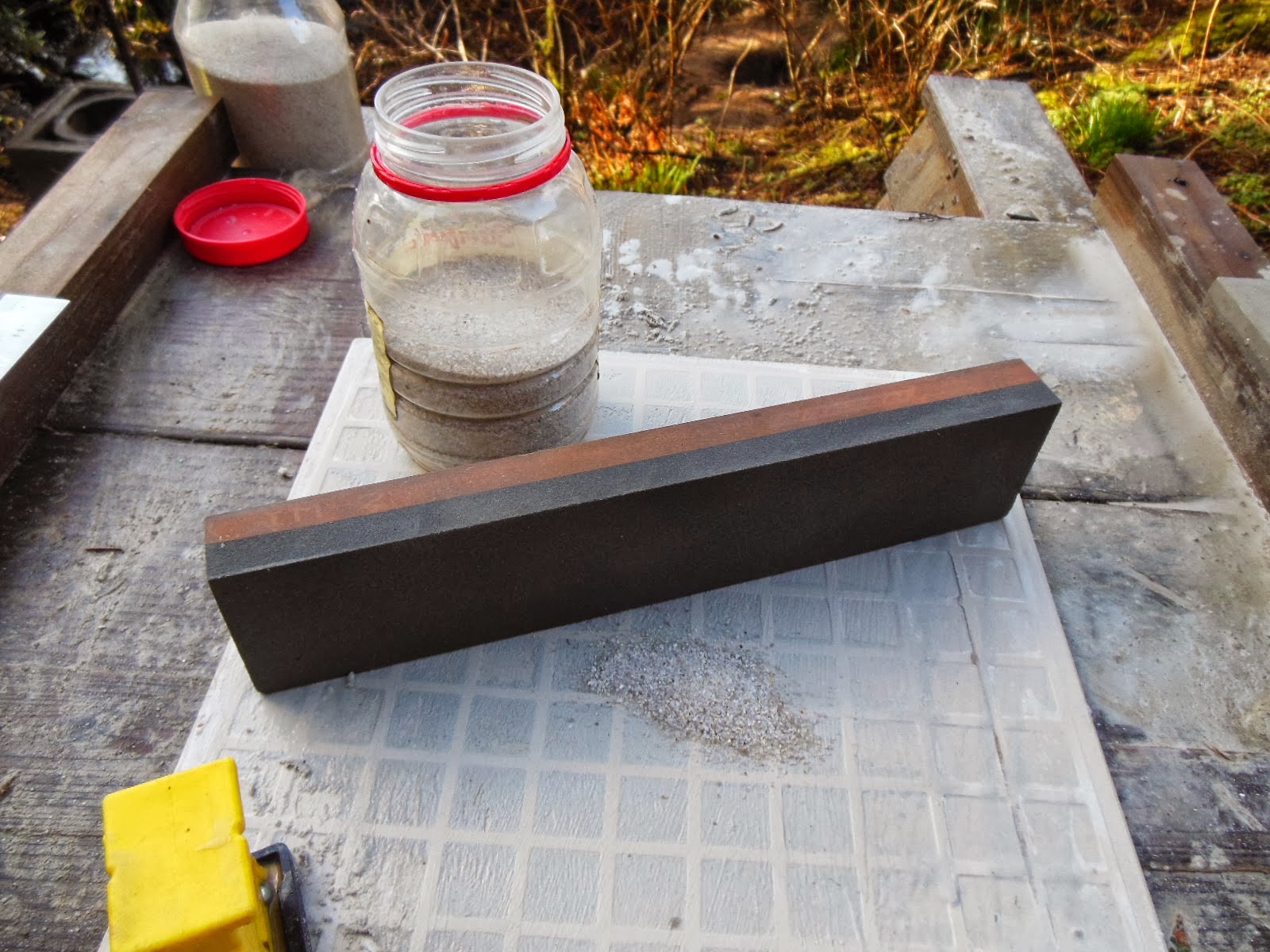


The carborundum side wasn't too photogenic, but it was SUPER fast and proved "proof-of-concept".


Make SURE that the bottom of the tile is as flat as you want your stone to be. I tried this without the grit and the results were underwhelming. The grit is key. It is only quartz sand, but it makes all the difference. Just sprinkle some around, add a tiny bit of water, and start rubbing.

T=0 seconds
I used the coarse grit for the carborundum side, but for some reason it didn't work well on the India side.

The fine grit worked great. It breaks down quickly, so just add more as needed. I used about 1/4 cup total. A $12 bag would be a lifetime supply (for you and your 300 SharpeNerd™ friends...).

This is the fine grit....

T=60 seconds

T=3 minutes or so
As the stone approaches flatness, the surface area increases and progress slows. Maintain your high standards! Flat is good.... and makes sharpening MUCH easier. You might have to apply more pressure to one end or the other. Use a straight edge.


T=8 minutes continuous ( 45 minutes if you count sprinkling, washing, squinting, and clicking).
This was used with oil, so there is some residual staining.


F is for flatness.... It's good enough for me......


You might not want to wear your best clothes, though....


Results? I've got a really hard laminated chip-breaker that need sharpening....

It feels like a completely different stone. Before, the blade just skated around and not much metal was removed. Now the stone makes a gawd-awful grinding crunch...... Obviously the stone was glazed with old swarf and grit filling the pores. Not anymore!

I am using water, not oil.


This is good, but the feel of the stone is...... unpleasant. 

My good friend ODC to the rescue.....


The ODC fills the pores without clogging them and smooths the action by forming a slurry. 


**This seems to be an important point**

In use, as the blade extends over the edge of the stone, it can grab slightly, digging in and marring the blade. This will prevent you from using the whole surface of the stone, which is what will eventually cause dishing, grooving, etc. My theoretical goal is to never NEED to flatten a stone, so I use every part of the stone and frequently check for high/low spots. The ODC  cushions or buffers the action by making slurry and reduced the feeling of "dragging". The blade is easier to control, and the whole surface can be used effectively. It also quiets the sound a bit, too (no small thing!).


India side.... Better than it was, but still slow. It feels like the metal is being scraped away, not cleanly sheared. This is partly due to using water instead of oil.


Pretty light....not much swarf, is there?


With the ODC?


Color! Again, a different beast.

I initially tried the coarsest W/D I could get, 220 grit, 2 sheets...... 30 minutes of work yielded little on the carborundum side, and even less on the India. Using loose grit quartz sand on an inverted ceramic tile, I flattened the carborundum side in maybe 2 minutes, the India in 8 minutes.

Physically the work is easier, too, at least as these things go. Sandpaper has a high coefficient of friction, whereas this is like rolling around on..... sand. Sandpaper tears. Sandpaper is expensive. This cost me a whole $1 for the tile (and the tile is virtually unaffected. Since I was using the back, the face is still good. I could even use it as a... tile!).

This combo-stone isn't as fast as diamond, but might actually work for me. With the ODC nagura.




Tuesday, February 25, 2014

Waterstone pond..... and accessorizing your sharpening stones


Rough stock. An old, decrepit sailboat, full of still valuable teak.

This


Into this 


A stone platform for a new waterstone pond.


Also ……

Old, OLD old-growth redwood, washed up on the Oregon coast about 6 years back. Some of it turned into windowsills for our house but this ribbon figured piece.... What will IT be?


The surface, as left by a Japanese plane, then a file.


 The plane gave a good finished surface with some minor blemishes, and just the slightest bit undulate.... Following the surface grain. I lightly hand sanded with 330 grit, even though I know better. Muddy. Then draw-file using a flat mill file. Better. VERY hard to avoid ALL tear-out, particularly in a such a soft wood as redwood.

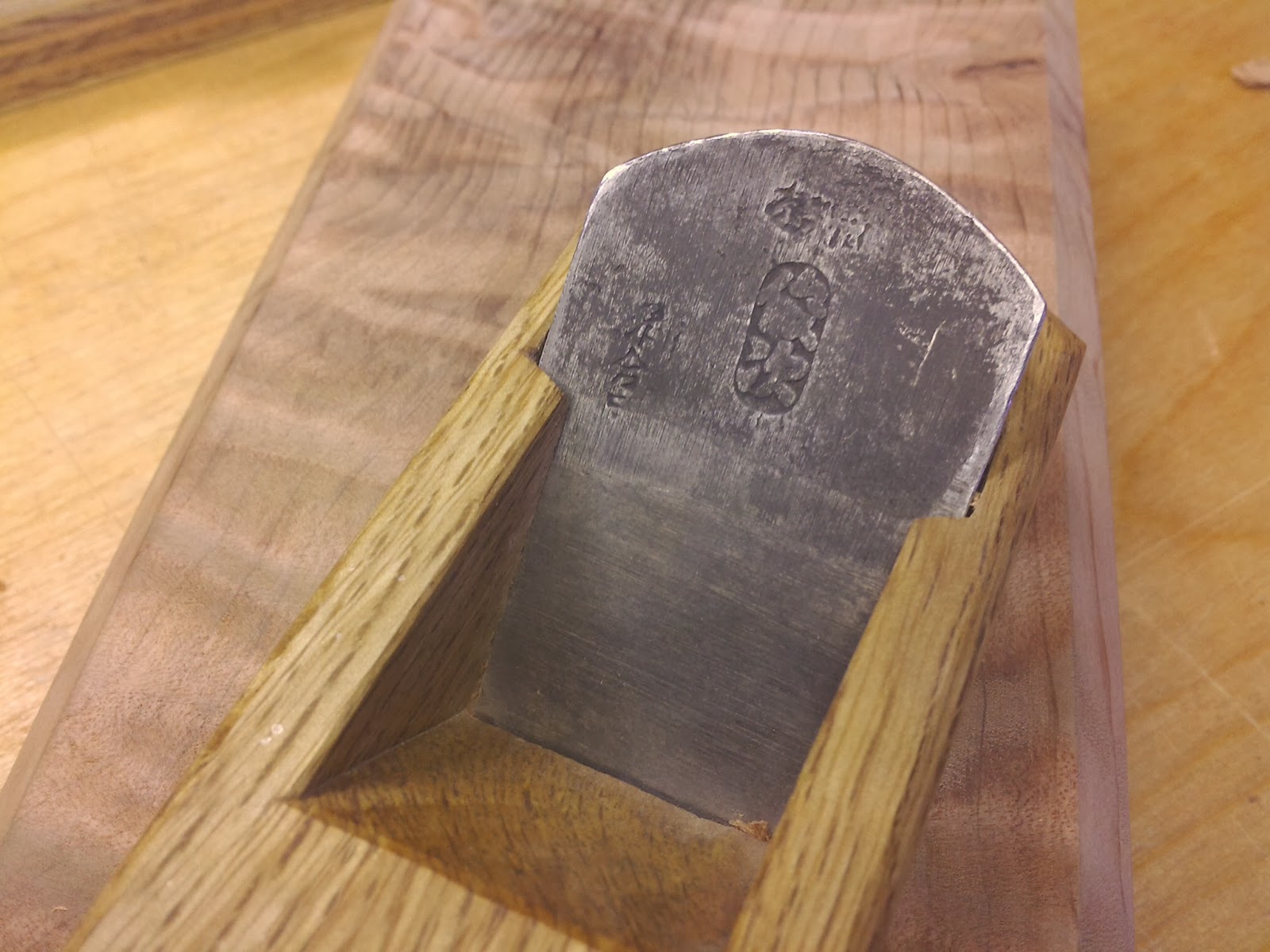
Still, I can do better..... A different plane, one of my favorites, a small 42mm ko-ganna, single blade. Bought from Junji (eBay seller yusui), then cleaned/tuned and put to work.


The kanji is hard to read. Nothing too special, just a good, user plane. The blade does use a nice ren-tetsu wrought iron for the backing metal, though. Each blade is different. I love that.


Tight mouth = reduced likelihood of tear-out.


Much better. Sharper grain definition. The sheen is back.


Notice the difference in surface quality. The chamfer is much rougher than the other two faces.


The rougher chamfer is the file finish. I may leave it this way, I haven't decided. And what is this to be, you may ask? My original intent is for it to be a box enclosure for a 1200 grit synthetic waterstone. Something practical for kitchen knives, and nice enough that it doesn't get stuffed into a drawer, never to be used.


The inside has been hollowed and will get lined with some thinly planed teak. The base platform will be Brazilian walnut...... We'll see.


I am of two minds divided. Stone enclosures, while great for oil stones, are less well suited for thirsty synthetic waterstones. Some man-made stones suck up a LOT of water and the box prevents drying out.....AND the man-made stones are messy, too. This kind of defeats the purpose of a nice box.


This is what is in our kitchen.....


.... an old carborundum oilstone in a simple, fitted mahogany box. It gives a nice, toothy edge to knives. I mostly use this dry, but sometimes with water. If I use a LOT of water, I can expect the box to swell/shrink for the next two weeks or so. A more rational mind might just use oil instead of water (so messy!) OR, say, cut the box for a looser fit, hmmm?


Rational..... bah!


Saturday, December 14, 2013

Natural Novaculite - Arkansas sharpening stones continued

So for starters, this is of course VERY subjective what I am trying to convey is my general impressions of the"feel"and efficacy of these rocks when used with water as the sharpening fluid. Why water?

I have used thin oil (baby oil) in the past, and while it worked very well for smoothing the action and flushing the old swarf away, the smell is unbearable. I find perfumy smells completely repulsive, but thankfully you can buy unscented baby oil in most towns, just not here. I used mineral oil thinned with unscented (haha!) mineral spirits. It works just fine and also seems to prolong the life of the sandpaper that I was using, much better than water. Interesting... Is the oil actually lubricating the abrasive grains and reducing the amount of shear forces being applied, reducing fracture? Is the water having a mild solvative effect on the abrasive itself or perhaps the reducing the adhesive bond? It FEELS like the oil had a greater cushioning effect, even when thinned to water consistency. I don't know if one works better than the other.

What I DO know is that oil is messy. VERY messy and and somehow spreads black nastiness everywhere. I also have a peculiar autonomic response that is triggered every time that I get my hands dirty, which makes my nose or eye itch. I've heard that others experience this odd phenomena. I guess that I am just not neat enough. At least oily tools don't rust as fast. That said, after I sharpen a tool I wipe it OFF using an old towel and then typically wipe ON a light oil. Talk about two faced. It is CLEAN oil, I suppose.


Mystery brown, soft Ark?, surgical black, medium Ark?, slate.


Also, as I may have mentioned, I found these stones to be more effective after creating a VERY thin slurry using a diamond stone. With no slurry they felt pretty lifeless, like not much work was being accomplished. So if you assume slurry, I'll spare the "before" photos.


Here is the medium Arkansas? with an example of a thin slurry. This was enough to completely change the feel of the stone.


Soft Arkansas? I liked this one. Tolerably fast, good feedback and left a finish comparable to a 800-1000 grit waterstone. 


I also tried using the side face of this stone to set the bevel on this old 1940's Japanese kitchen knife. My wife's grandfather brought it back after being stationed in Japan after WW2. It is laminated construction just like the chisel, with a very soft backing iron that tended to load up and clog the stone but was easily cleaned using soap and more water. It WAS quite a bit faster cutting than the top face, but slightly coarser, maybe 600 grit. Also interesting is that out of all of these stones, only the slate brought out the contrast between the hard steel and soft iron. The Arkies made the lamination line less distinct.


Medium Arkansas? A fair bit harder, slightly finer finish (1200'ish) but feedback was vague and the cutting action was pretty slow.


This mystery stone is a light/dark, mottled brown, possibly a hard Arkansas? So hard that neither Brandon nor I had the patience to do a first-class job of lapping it flat. It was probably a fair bit lighter in color before decades of oil and steel residue soaked in and turned it dark, and is not quite translucent. The grain structure seems more fine then the Novaculite. It is very dense and fine on the top face, kind of glassy feeling but polished nicely to around 3000 grit or higher. The side face was much faster and had better feedback, but again was more coarse at about 2000 grit.


This is a little slip of slate or very fine shale. VERY fine with faint sedimentary layers, this guy produced a finish of approximately 8000, and if continued, up to about 10000 as the slurry broke down. Speaking of slurry, this stone made its own, a very creamy viscous light gray and the stone was pretty hard for slate. A beautiful polisher, I would love a piece of this in a larger size. Brandon will keep this one for carving tools (smart man).


Surgical black Arkansas (with an Umehiro chisel) and lots of ODC slurry.


Different chisel, different slurry (diamond, I think)

This is a big, beautiful, surgical black Arkansas stone from Hall's sharpening stones. I was REALLY curious to find out what kind of edge I could get with this guy. VERY hard and glassy. Using water and no slurry, this stone had just a hint of feedback to tell you that it was doing something and gave a very polished edge, but felt more like burnishing than actual cutting. No depth to the look of the steel.

This stone has been used and lapped with diamond stones, but even so, STILL has the factory lapping/scratch marks visible! REALLY hard! Fortunately it is pretty flat and should stay that way, oh, pretty much forever. Do not let one of these get dished out!

 Using a diamond stone to raise a slurry was a lot of work and the slurry did   improve the feedback a bit, but as the slurry degraded, that was it. No new slurry was produced, the stone is THAT hard. It does cut though, just very slowly. I tried making slurry with a few different types of stone: bare (poor), diamond  (this would be surgical black slurry, fair), soft Arkansas (good, but didn't last long enough), mystery brown (fair), slate (good for polishing), and ODC (volcanic tuff, good).

The best slurry was made using the ODC nagura and used in the classical straight razor fashion. Make up a fair bit and just keep at it, allowing the slurry to degrade and dilute until you are finishing on just the bare stone itself. VERY polished edge! This would be a good stone for razors and, like a true razor hone, you would just need a variety of slurry stones to get the type of edge that you want. I found it too slow for tools, with one exception. It is GREAT for lapping backs of chisels and plane irons. Because it is SO hard, you can apply all of the force that you want, with no fear of dishing out gouging the stone.

If you just want sharp tools without spending much money, you can't beat old oilstones. An old soft Arkansas (or an India stone synthetic), a hard Arkansas, and a piece of very fine slate would be perfect for classic carbon steels. Some say that once treated with oil, they are ruined for water use forever. That  MAY be true to a degree, but is mostly a load of crap. They still do work. They work well enough for me, anyways. Old, used ones are ridiculously cheap because they are not currently "cool". What you get is sharp tools forever and a stone/tool that will last for GENERATIONS! There is NO higher ROI (return on investment) than that of sharpening stones.

Fancy, new steels need more extreme measures, but I don't need that stuff. It WILL get dull sooner or later, and then you need to sharpen. Have fun with that!  Learning to sharpen, REALLY sharpen, had been the MOST valuable skill that I have learned. I can't emphasis this enough, it has been a game changer. I wish that I had learned sooner, like 30 years ago. Back then I just wanted to build things, not spend a bunch of time polishing edges. I mean, if it cuts wood, it's sharp enough, right?

I feel like I've been sitting in a dark room and have just figured out that there is a light switch. What will I see when the light comes on?


Monday, December 9, 2013

And now for something COMPLETELY different.... Novaculite sharpening stones

My daughter Eliana was helping me the other day by peeling the a bark off of some branches that we dragged out of the back forty (we have decided to make a "real" cat tree). She decided that this would be a good opportunity to use some of the SHARP tools. Only 8 years of age and already a tool snob, I love it!


Bevel down, cut away from the body, smart girl.


Maybe I'll try the spokeshave....


Yeah, this works.

Well, you know what that means.....


More tools to sharpen, yay!

It just so happens that my friend Brandon, knowing well of my sharpening stone obsession, had dug out some of his old oilstones for me to play with.


Brandon on his sailboat.


Arkies, Indies and Blacks, oh my!


My oilstone experience is limited to say the least, extending to India (synthetic) and probably hard Arkansas (natural) stones, so this was a real treat. Brandon knew that I would be trying them out as waterstones, so he even had them all washed up and lapped for me, aawwww. I grabbed a handful and ran for the door/hatch/ companionway.


Strange days, snow and ice on the Oregon coast (also lots of glare, contributing to particularly bad photos).


From left (these are guesses): hard Arkansas, soft Arkansas, surgical black Arkansas (certain!), medium Arkansas, and some type of slate (very fine).


One thing I noticed right away. One of MY mystery stones (the small one) bears more than a passing resemblance here. Look, I learned something already!

I also learned something else. These stones work well using a thin oil, but if you lap them fine and try to use them with water.....


Not much happening.... more burnishing than cutting.


Make a thin diamond slurry....


That's more like it. Lots of swarf.


It's pretty neat. Just water, and the stone feels like it's rubbing or dragging but not working too well. Make a very thin slurry, just 2 or 3 seconds work, and it acts as if it's a completely different stone. Suddenly there is some feedback and the slurry turns black with metal particles. Kind of like a waterstone...... but slower. The good part is that they are harder than most waterstones, so you don't have to be QUITE as diligent about flattening. Oh yeah, MUCH cheaper than natural waterstones, too.

But wait! There's more......


Sunday, November 3, 2013

New November Novaculite?

A cold and rainy day. Perfect for thinking about work instead of doing it. I got a new rock yesterday. Evidently from a farm auction in Iowa, owned by a rock and gemstone collector....

In all it's greasy glory. Any ideas? Washita stone?

New/old stone, as received. Arkansas? Lily White? 102-50-28 mm
I scrubbed it down using dish soap.

Looks a bit better. Still dirty though.

Bath time!

After boiling and lapping. Purple and rust colored lines, works great, very fast and smooth, no nagura needed (say that 5times fast), white and purple slurry, med/fine finish.

The stone is an off white/cream color with a relatively coarse grain structure. Quartzy looking, more than chert. 
So there you have it. I have no idea what it is, mostly because I know so little about oilstones in general. It is a very pretty stone, lighter in person than the photos show, works up a black swarf very quickly using only water and I wish it was about 10x as big. I'll put it to work and report back later. Outside input from those in the know would be welcome.