Showing posts with label ODC. Show all posts

Friday, February 14, 2014

Waterstone reality.... an Asagi of Indeterminate Origin (AIO), part 2


Slurry slurry slurry...... A funny sounding word in its own right, and it just gets MORE odd when you use it.


DMT #1200 slurry.


This is new territory for me, in terms of natural waterstones. My finest stone is a koppa (piece or splinter, sort of) Ozuku asagi, but this stone is finer yet and the action is smoother without being soft. Really easy to use and FAST, for its grit. I thought that the Ozuku was relatively fast, but THIS waterstone is about 4x faster! When I close my eyes and touch the Ozuku, I think of a blackboard, a writing slate, cold, sharp. When I touch this stone, I think..... cool, firm, a hard surface dusted with powder...


I want to try this stone with the ODC, but first I need to go back and do a bit more ground work..... and a reality check.


T=30sec. each stone (I'm not hardcore or anything).

This is the "ink" stone and the Ozuku asagi, using the ODC nagura. The slurry on Inky has oxidized to more of a gray/brown, but it was black a few seconds ago. The slurry of the Ozuku is still black. I am concentrating on polishing just the steel, so I am using a stroke parallel to the cutting edge.


When I use the ODC, I give the stone just a few swipes, barely enough to see. It is a VERY mild abrasive and as the ODC breaks down, it seems to expand about 10x in volume. Strange stuff.


T=15sec.

Even stranger..... With this stone, the slurry forms but only gets a bit darker, a gray tinge. "Normally" the ODC breaks down and quickly turns black with iron particles. With this stone, the slurry just sits there, as though the stone isn't working..... VERY interesting!

I THINK that what is happening is this......


A typical natural waterstone is composed of a range of particle sizes that are mostly larger than the particles of the ODC. The smaller ODC stuff acts as a cushion or filler, reducing the metals exposure to the abrasive. As the ODC degrades, more of the base stone's surface is exposed. In effect, the largest, most jagged particles are buffered by the ODC until they are worn down to a common size with the other abrasive grains.


 The slurry is the worn and degraded particles that have been dislodged from the parent stone. They both abrade the tool steel surface AND the stone surface as they get ever smaller.....


This stone behaves differently, with the ODC slurry at least. Magnify the last drawing 10x....


This stone seems to have an average particle size that is slightly SMALLER than that of the ODC. The ODC is masking or preventing the steel from making contact with most of the parent stone. Only a few particles are larger than the ODC, so they would be responsible for the slight darkening in color of the slurry. 

I feel that this is significant. I think that I have found the practical limits of the ODC nagura. This speaks well of both this stones quality AND the utility of the ODC nagura. WAY cool!


T=15 sec. 
No nagura and almost no slurry formation, but the stone doesn't feel super hard and is quite friendly. That dark patch on the upper left corner of the stone is basically all swarf. Amazing.


Full mirror on both steel (hagane) and iron (jigane). This blade is harder than most and somewhat special.


 Different blade, still good, but not AS hard. About as hard as my daily "users".


T=15 sec
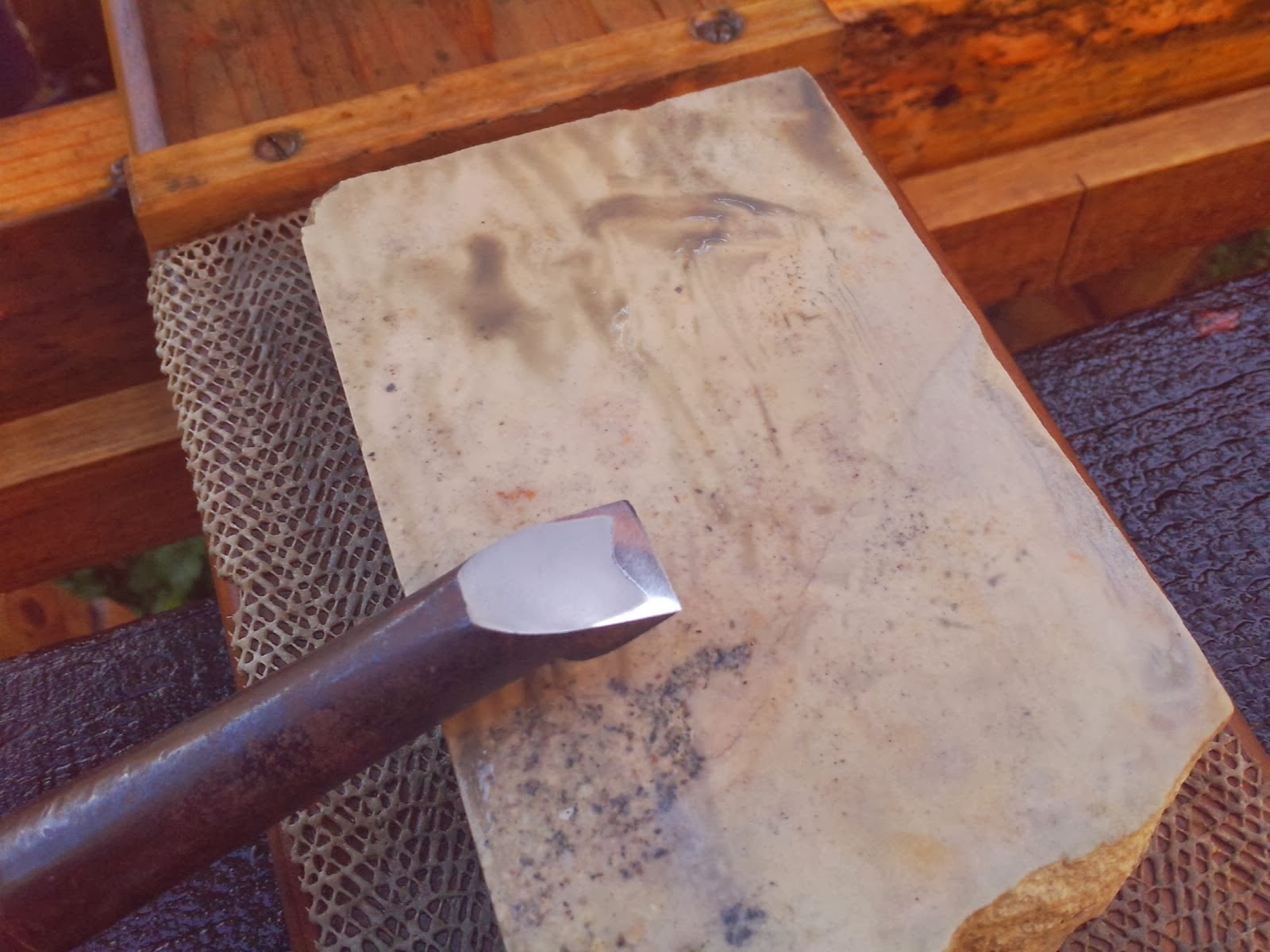
I set the bevel to the stone, close my eyes, and slowly "guide" the blade. You can "feel" the stone remove the metal. I haven't felt ANY scratchy bits yet, not even the two dark spots. 

This bevel is reasonably flat and, if you look close, you will see some rust pitting but almost no scratches left over from other stones. 


Like I said, this is new sharpening stone territory for me, and I think that I know why.

Alex Gilmore at The Japan Blade  has a few stones that look similar, like this beauty....@$2,100!

Nakayama Maruka awasedo ttoishi


Here is my AIO again.


Very similar, especially the skin, although his are stamped and have a known provenance. If you go to his site (Item Nakayama #19), you can watch a video of his stone in action. The speed of metal removal is comparable to mine.... incredibly FAST!

I must admit to a certain degree of , not scepticism but maybe uncertainty, about how GOOD these old Toishi were/are. These old premium stones are an order of magnitude better than anything that I have used to date.

This is my A-team grit progression.... Inky, Ozuku, and AIO.


The bar has been raised.


Monday, February 10, 2014

The search continues.... native natural sharpening stones


A picture can reveal so much...

If you look to the top of this picture, you will see the bottom/sole of one of my kanna... the lighter patches are rub marks from planing. There should be just 3 bars, not multiple patches. Time for a tune up! I did the other 2 kanna a couple of days ago, but obviously forgot this guy. Add to list...


I am building a new pond for the waterstones. A heavy plastic bin with a teak platform. And, yes, I do use that many planes. I am ACTUALLY in the middle of making some windowsills and that is why there are all of these tools laying about and to have as MANY ongoing projects as possible seems to be my ideal.


Speaking of too many projects...The cold snap has broken and it's time to look for new rocks..... Sharpening stones, that is.


I tripped on this guy on the way to the compost bin. I noticed the lines of relatively perfect cleavage and thought.... Well, you know what I thought.


A couple of taps with the chisel and... Almost perfect! The is some interesting silica solute (I think) that had seeped into the fracture eons ago. Interesting....


As a fall back, I also grabbed this from the yard. We have any number of round stones in the yard, but this one had that..... rough, sandy, gritty feel to it. Abrasive! Most of the other round yard rocks are more smooth to the touch.


They don't always split as nicely as you might like...

One hour later.


I grabbed a few kanna blade from my "magic box" to test out these new prospects. All seem to be good quality with nice ren-tetsu wrought iron. FYI, I have NO idea what type of steel is used on these blades, so any results are, well.....


Wet


This stone reminds me of one of those really hard aoto that I have been been wanting. Could this be my lucky day? It was easy to work with the diamond wheel, but the hand grinding portion was tedious. 


The feel is a bit rubbery, like the blade is dragging slightly. Not scratchy at all, though. Also not much grinding OR polishing.


I raised a slight diamond slurry


The slurry color is basically unchanged after 15 seconds and the appearance of the bevel reflects that. This isn't working.


ODC nagura


Well, that settles it. Still no love. The ODC nagura will not magically transform EVERY rock into a super sharpening stone (SSS). I was looking forward to writing a post about how I can transform a brick into the world's greatest hone, using only the ODC, but......


Maybe the other rock will perform better..... Cont....


Thursday, February 6, 2014

Waterstone dreams----- new "locals" and an old Japanese natural asagi kerasu sharpening stone?


It is the beginning of February and (Gasp!) we have snow! On the Oregon coast, go figure. This all makes makes me think of Rudy of Geological Specimen Supply, down in the California desert......

I keep going on about the ODC nagura that I use with nearly all of my sharpening stones. Yesterday I even used it with one of those India/Crystolon combo stones that I am getting from my friend Brandon and it caused such a notable change that I will be doing a separate post, just on that combo.

But for the record.....


I tried this, but it was a bit hard and my sample ended up fracturing. These are stones, after all.


The fragment worked great with this super hard chisel. That was WITH the ODC, though.


I also got a sample of welded volcanic tuff..... Interesting stuff.


Variable, pretty fast, and looks a lot like......


This is a photo from Tanaka Kiyoto and his AMAZING blog. To paraphrase, these are from different regions, but the center stone feels like tuff, while the ones on either side feel like sandstone, and the stone compare to a #400 grit. It turns out that a fair number of Japanese waterstones are volcanic tuff. Cool!


Here are some stone samples that I hope to try out in the near future....


VERY fine grain abrasive, might be too delicate?


-------SANDSTONES-------

If natural sharpening stones have one area that they do poorly in, it would be for coarse grinding. The rough stones have the reputation of dishing badly and being SLOW, SLOW, SLOW...... Is this REALLY the case? Coarse is a very relative term, but I am thinking of the #400-#1000 range. I have been using this sandstone that I grabbed off of the beach.... and the more I use it, the more I like it.


It feels very soft for a stone. Smooth, yet has a good crunchy sound, and is surprisingly resistant to dishing. About as good as my King 1200 synthetic, anyway. It IS kind of slow, but not as slow as you might think, is not muddy, but it feels like it would dissolve if you left it in the water bucket, so water control is important. I use it right after the King 1200, even though the grit is more coarse. It leaves a nice, shallow scratch pattern that is very easy to erase with the next higher grit, UNLIKE the K1200. When the weather breaks, I need to find a wider one.


Rudy has some interesting looking possibilities....


Looks like any number of coarse Jnats that I've seen.


Ditto.


VERY familiar looking, Kohzuke or Tajima perhaps?


LOTS of the better performing/faster Jnats are diatomaceous shale/slate.


Natural pigment!


I have been so pleased with the results that I have been getting with relatively local rocks that I start to think, "Why use Japanese naturals at all?"


!!HAHAHAHAHAHA!!

Last night.......


Not much to look at and hard to tell the true color, but it appears to be a very light asagi blue. About 210-70-45mm or so.


A full skin (kawa) back, black with brown (or maybe just rust staining) and a hint of black kerasu. Kerasu stones have the reputation of being very strong sharpeners. 


45mm thick! And even! This looks like unsold merchandise from an old Japanese hardware store and may never have been lapped. Patches of kerasu?


It looks to be a very fine grain composition and when I look REALLY close, I think that I can see very slight fractures of the working surface that you will see on some really hard stones before they have been polished. Think of very slightly translucent marble, if that helps. You can also see the tell-tale marks from a 1/4 sheet sander! This seller seems to hit all of his tools with one to "freshen" them up *sigh*. It doesn't seem to hurt his sales any, he is a real nice guy, very responsive, and ships super fast!  japan-treazures 

This stone reminds me of some pictures of other stones that I've seen.... Old Nakayama storm cloud asagi kerasu, blue ghost kerasu... 

Interesting, but none of that really matters, these are just names to me. These are just dreams. What WILL be interesting is how the stone works. That is the realty. 

Next week.


Sunday, January 12, 2014

Time is on my side - petrified wood sharpening stone

So, since I've recently been working with Sheetrock, plaster, and tape, my poor little brain has been getting all twitchy because a few days have passed without me sharpening anything.-- *sad*--

I had heard somewhere that you could use petrified wood as a sharpening stone. Hmmmm......


The small piece was a test and.... it actually did something! Go figure. It is no surprise that it would scratch the metal since petrified wood isn't actually wood at all, but more of a wood shaped piece of quartz. The process is called permineralization and the Wikipedia gods will tell you all you need to know about that. I, on the other hand, can tell you how to sharpen a chisel using a fossil. Maybe I can contribute an entry?

Anyway, what surprised me was that the scratch pattern was actually fairly even with a slow, but respectable, rate of metal removal. It even felt like a sharpening stone. Decent feedback, a tendency to"squeak" and grab-the-earth at times, and VERY little slurry production because the stuff is pretty hard. That said, it only took me about 15 minutes to turn this chunk of fossil into a sharpening stone.

I polished the flat grain face to 1200 grit and when I get around to it, I'll stick it onto a piece of stone to anchor it.
While not the fastest stone around, it is definitely a keeper. My wife's grandfather picked it up who knows how long ago, so it has history in more ways than one. And it looks cool!


How did it work?


We'll start with the Frankenstone (3000-5000)


Too hard, needs slurry.


DMT 1200 diamond nagura.


Black swarf ( it's working!)


Not too bad...kinda slow, but pretty smooth, some scratches but shallow.


Not a full mirror, but close. Definitely shiny steel and some superficial shine to the iron/jigane.


Control/reality-check. Ozuku asagi. Faster, smoother, and only the finest of scratches. Perhaps not a fair comparison?


The green mystery inkstone. This feels very similar in use and the scratch pattern is similar. This IS faster, though.

Let's mix it up even more. I'm going to try using the P-wood with the ODC nagura.


Faster metal removal, smoother action and just all-around easier to use. The ODC gives a nice even matte finish to the jigane. I like that.


Still WAY better. Ozuku asagi w/ODC. Faster, smoother, easier. Nice definition. 


Well, you can't have too many sharpening stones. This was just sitting in a shoebox and, surprise surprise, it works like your average super-hard Japanese natural waterstone. Not the greatest, but definitely interesting. I looked at some other pieces of petrified wood at a store in town, most of which looked like rocks. Agate or something. This piece is probably an example of incomplete metamorphosis and still looks a fair bit like wood. A conifer of some sort.

When I first got interested in natural sharpening stones, I thought that they were very rare and special (well, the best ones ARE!) but it turns out that the darn things are everywhere. The trick is to first learn how to use natural stones and having a "real" sharpening stone will help. That way, if you are having problems, you will know that the fault lies with your technique. The stone is a known quantity. The second thing would be that a nice stone makes sharpening fun ( well, some of us are easily entertained....), but a bad one will keep you from ever learning anything because you won't use the darn thing. Then you're back to the whole dull tool situation. Also, as you get better, your preferences and priorities will change, so don't sell the farm just to buy into some system. Ebay is full of "systems" that someone else outgrew. At the least, buy used and let someone else pay the depreciation.

I wish that I had learned some of this stuff sooner.